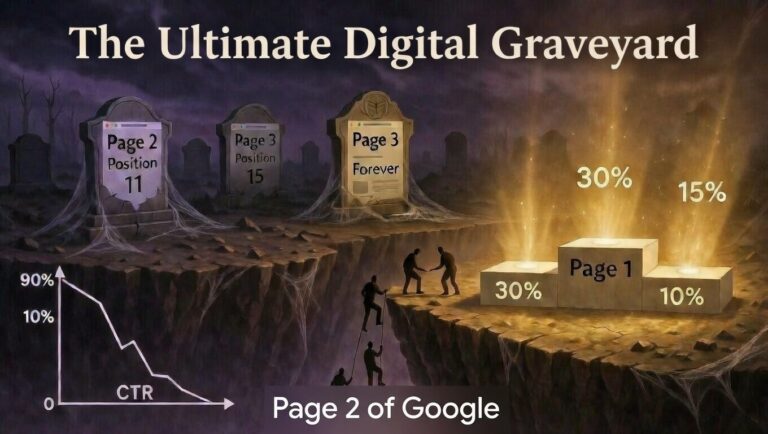
There’s a dark joke in the SEO world: “If you ever need to hide a dead body, put it on the second page of Google search results.”
Macabre? Sure. But it captures a brutal truth about how people actually use search engines.
We’ve become a “top three or bust” society. If the answer isn’t visible within a half-second scroll, it might as well not exist. Page 2 isn’t just less visible—it’s a digital graveyard where content goes to be forgotten.
And if your business is stuck there, you’re technically “ranking” while being functionally invisible to the vast majority of your potential customers.
The Mathematics of Invisibility
The data here is striking. Research consistently shows that the drop-off between the bottom of page one and the top of page two is catastrophic:
|
Search Position |
Average Click-Through Rate |
|
Position 1 |
30-40% |
|
Position 2 |
15-18% |
|
Position 3 |
10-12% |
|
Position 10 (bottom of page 1) |
~2% |
|
Page 2 (anywhere) |
Less than 1% |
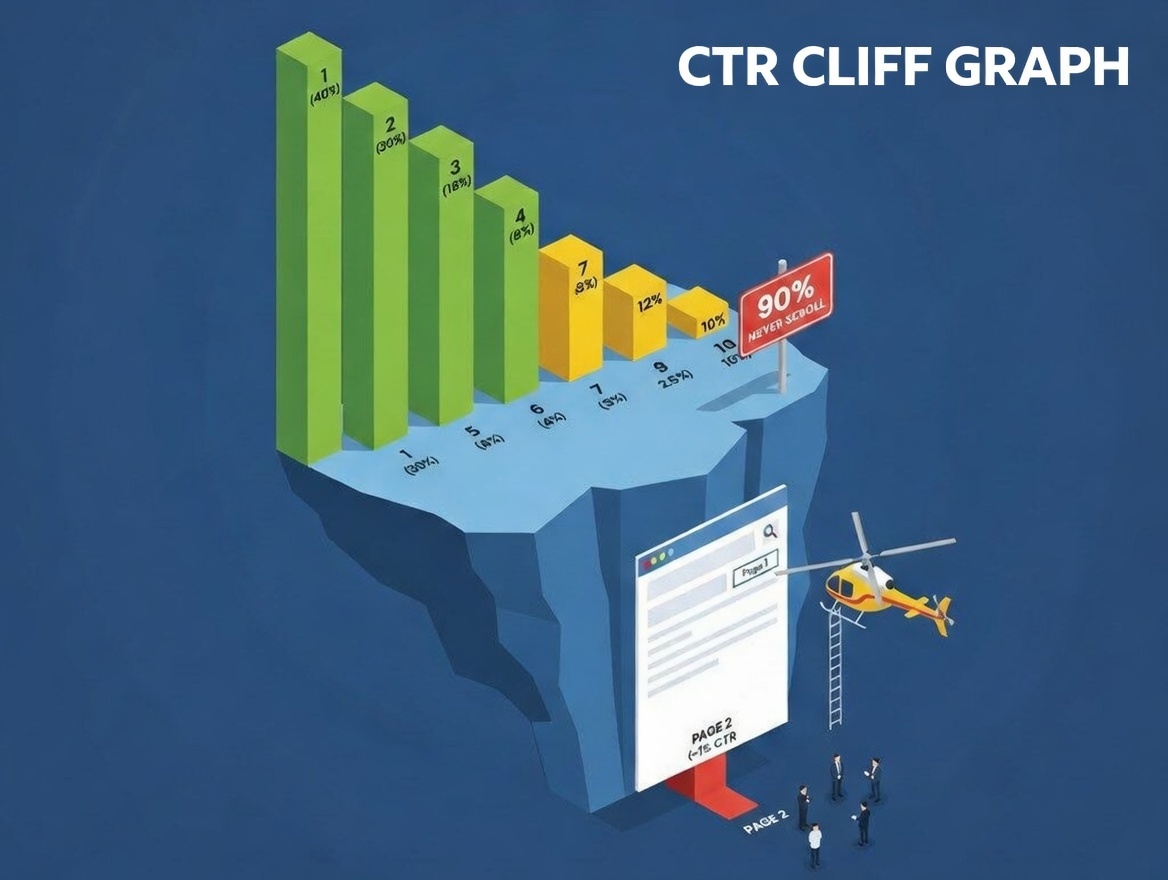
Think about what that means: over 90% of users never click past the first page.
If you’re ranking at position 11, you’re technically a “top result.” You’re close. You’re relevant enough that Google considers you worthy of ranking. And yet you’re invisible to 9 out of 10 people searching for exactly what you offer.
Position 11 isn’t 10% worse than position 10. It’s a cliff.
Why We Don’t Scroll ?
This isn’t laziness. It’s psychology and design working together.
The Authority Bias
We’ve been trained to trust Google’s algorithm. If a site appears at the top, we subconsciously assume it’s the most credible, most relevant, highest-quality answer to our question.
That trust has been reinforced billions of times. Google shows us something, it’s usually good enough. Why would we look further?
The “Good Enough” Standard
Most searches aren’t complex research projects. They’re quick questions:
- “weather tomorrow”
- “pizza near me”
- “what time does target close”
- “how to remove red wine stain”
If the first few results answer the question, there’s zero incentive to keep looking. The user got what they needed. They’re done.
Decision Fatigue
Every click is a small decision. More options create more cognitive load. The brain conserves energy by defaulting to the easiest choice—the top results that have already been pre-filtered.
Scrolling to page 2 means actively choosing to reject the options Google prioritized and continue searching. Most people won’t make that choice unless the first page completely fails them.
Zero-Click Searches
Here’s the trend that makes page 2 even lonelier: users increasingly don’t click anything at all.
Google’s featured snippets, AI overviews, knowledge panels, and direct answers mean users often get what they need without ever clicking through to a website. If they’re not even clicking page 1 results, they’re definitely not reaching page 2.
The Page 2 Problem for Businesses
If your website ranks on page 2, you’re experiencing:
Lost traffic. The math is simple. Less than 1% click-through means you’re capturing almost none of the search demand for your keywords—even though Google considers you relevant.
Lost credibility. Users don’t consciously think “this business is less trustworthy because it’s on page 2.” But the authority bias means top results get implicit credibility, and you’re not getting that benefit.
Lost revenue. Traffic is at the top of the funnel. Less traffic means fewer leads, fewer conversions, fewer customers. The business impact is real.
Competitive disadvantage. Someone else is sitting in position 1-3, getting the clicks, building the relationships, capturing the customers who should have found you.
And here’s the frustrating part: you’re close. Page 2 means Google recognizes your relevance. You’ve done enough to be considered. You just haven’t done enough to break through.
Why Page 2 Isn’t Hopeless ?
Before you despair, recognize what page 2 actually means:
You’re in the game. Google thinks you’re relevant for these searches. The pages on page 200 don’t have that. You’ve established a foundation.
You need a push, not a rebuild. Moving from page 10 to page 1 is a massive undertaking. Moving from position 11-15 to positions 6-10 (and eventually higher) is achievable with focused effort.
Small improvements compound. You don’t necessarily need to rank #1. Moving from page 2 to position 7 can meaningfully increase traffic. Then you optimize from there.
The question is: what’s the push that gets you over the threshold?
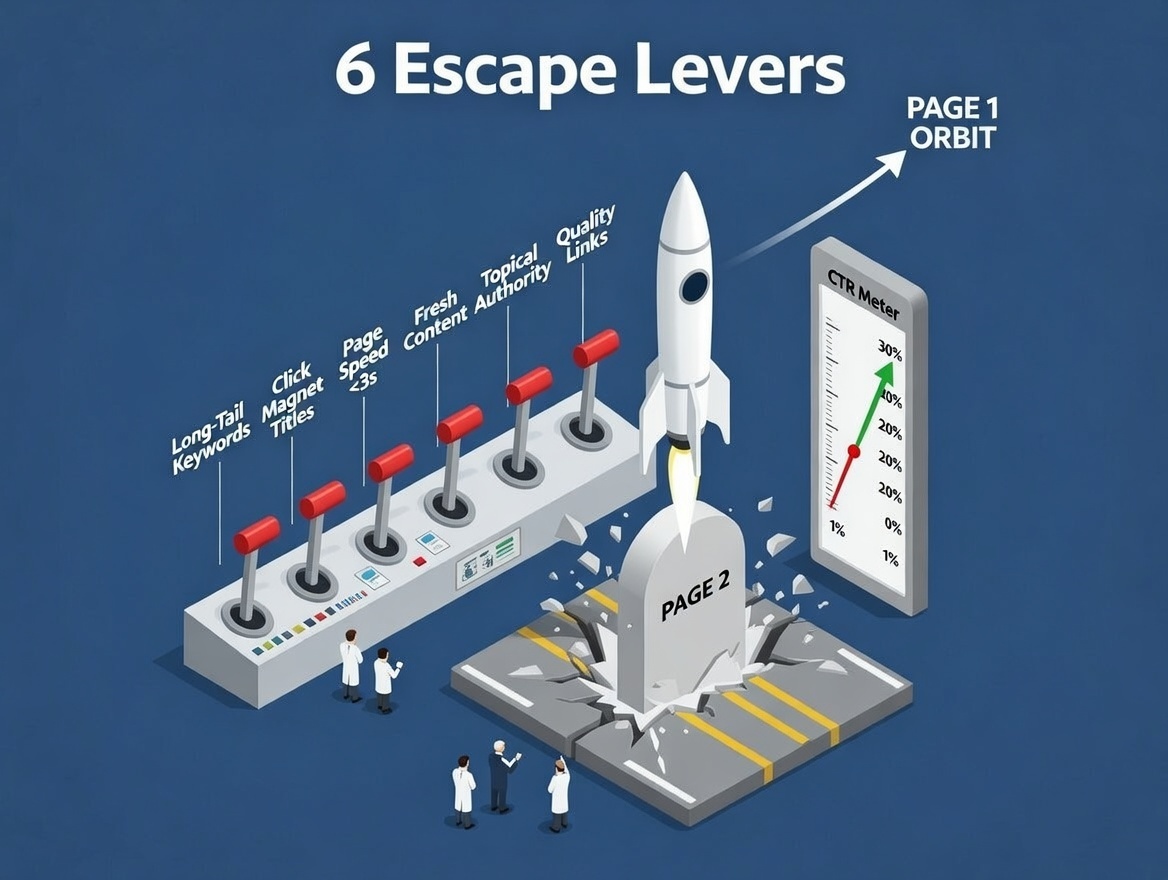
Escaping the Page 2 Graveyard
Here are the strategies that actually move the needle:
1. Target Smarter, Not Broader
Sometimes the problem isn’t that your content is weak—it’s that you’re competing in a category too crowded for you to break through.
The solution isn’t fighting harder for “bakery.” It’s dominating “organic sourdough bakery North London.”
Long-tail keywords have less search volume but dramatically less competition. You might rank #1 for a specific phrase and get more traffic than ranking #11 for a broad term.
Ask: Are there more specific versions of your target keywords where you could rank #1 instead of #11?
2. Optimize Your Click Magnetism
Even if you improve your ranking, you need clicks. Your title tag and meta description are essentially your ad copy in search results.
Make them count:
- Include your target keyword naturally
- Create genuine curiosity or urgency
- Promise clear value
- Stand out from the boring titles around you
Compare:
- “Bakery Services | CompanyName” ← Nobody’s clicking this
- “Award-Winning Sourdough Delivered Fresh (Order by 2PM for Same-Day)” ← Specific, valuable, actionable
Better click-through rates can actually help rankings—Google notices when users consistently choose your result.
3. Page Speed Matters More Than You Think
Google explicitly uses page speed as a ranking factor. But more importantly, slow sites have higher bounce rates—and bounce rates affect rankings too.
Targets:
- Under 3 seconds load time (ideally under 2)
- Mobile performance optimized (most searches are mobile)
- Core Web Vitals passing
If your page takes 5 seconds to load, you’re fighting with one hand tied behind your back.
4. Update and Expand Your Content
Google loves “freshness.” Content that was updated recently signals ongoing relevance.
Quick wins:
- Add current year to titles where appropriate (“Best Sourdough Bakeries in 2026”)
- Update statistics and examples to current data
- Expand thin content with more depth
- Add new sections answering related questions
You don’t need to rewrite everything. Strategic updates can be enough to trigger a ranking boost.
5. Build Topical Authority
Google increasingly looks at whether your site demonstrates expertise across a topic—not just on single pages.
If you want to rank for “sourdough starter guide,” it helps to also have content about:
- Types of flour for sourdough
- Sourdough fermentation science
- Troubleshooting common sourdough problems
- Recipes using sourdough discard
A cluster of related, high-quality content signals that you’re an authority worth ranking.
6. Earn Quality Links (Still)
Despite years of “links don’t matter anymore” claims, backlinks remain a significant ranking factor.
Focus on:
- Links from relevant, authoritative sites in your industry
- Genuine editorial mentions (not paid placements)
- Quality over quantity—one link from a respected source beats twenty from random directories
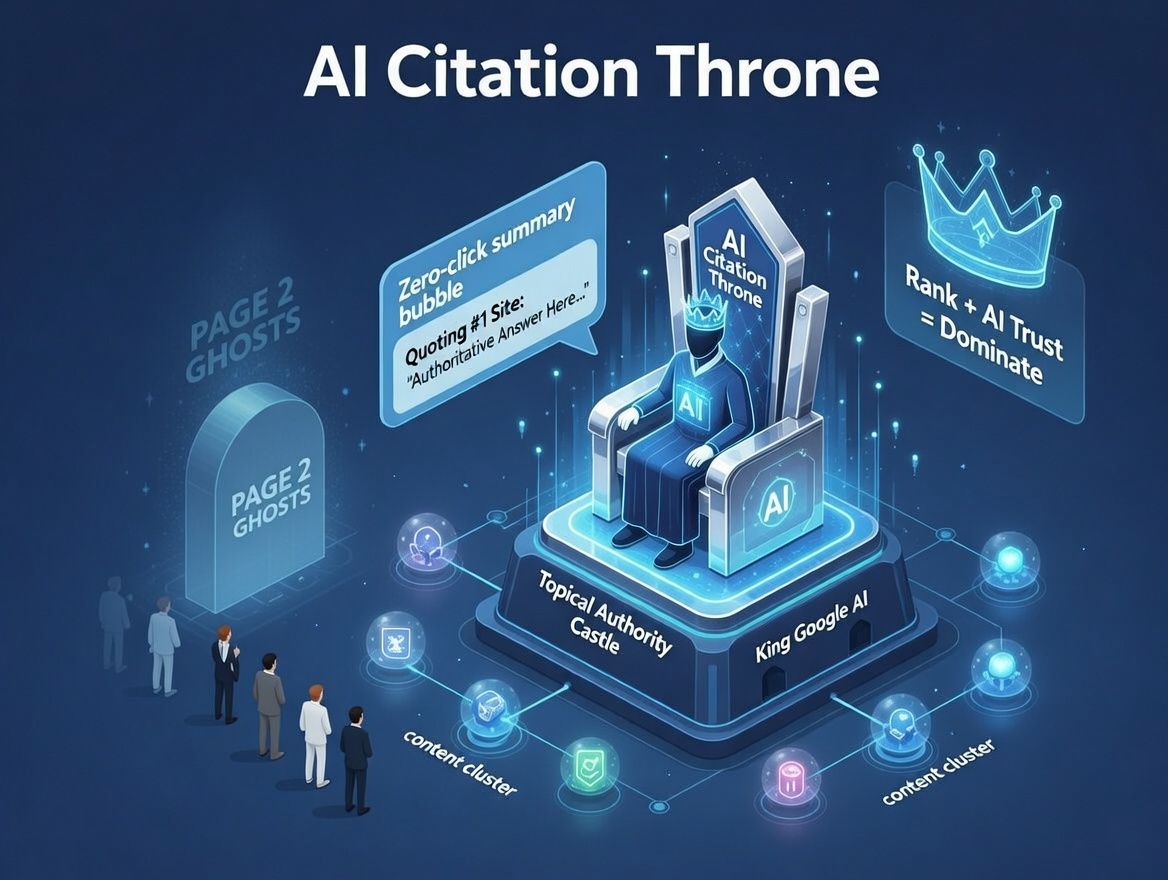
The GEO Dimension: Beyond Page 1
Here’s where modern strategy gets interesting: the game is changing beyond traditional rankings.
With AI overviews, featured snippets, and generative search, “ranking #1” might not even be the goal anymore. Users increasingly get answers without clicking anything.
The new frontier is being cited by AI systems—showing up in Google’s AI-generated summaries, being referenced by ChatGPT, appearing in Perplexity answers.
This requires:
- Content structured for AI extraction (clear headers, direct answers)
- Demonstrated expertise and authority
- Information that AI systems can confidently cite
The businesses that dominate the next era of search won’t just rank well—they’ll be the sources that AI trusts.
The Bottom Line
Page 2 of Google isn’t a mild inconvenience. It’s practical invisibility. The math doesn’t lie: over 90% of users never get there.
If your business is stuck on page 2, you’re leaving money on the table. You’re losing customers to competitors who’ve cracked the code. You’re maintaining a digital presence that almost no one sees.
The good news: page 2 means you’re close. You’ve earned Google’s attention. You just need the strategic push to break through.
Whether that means targeting smarter keywords, optimizing your click-through elements, speeding up your site, or building topical authority—the path exists. The question is whether you’ll walk it.
Because the second page of Google really is where content goes to die. And your business deserves better than the digital graveyard.
Frequently Asked Questions
Why is page 2 of Google so bad for traffic? Over 90% of Google users never click past the first page of results. The drop-off between position 10 (bottom of page 1) and position 11 (top of page 2) is dramatic—from roughly 2% click-through rate to less than 1%. Being on page 2 means being functionally invisible to most searchers.
What percentage of clicks go to page 1 results? Studies consistently show that page 1 results capture over 90% of all clicks, with positions 1-3 getting the majority of that traffic. Position 1 alone typically receives 30-40% of clicks for a given search query. Page 2 and beyond share less than 10% combined.
How do I move from page 2 to page 1 on Google? Focus on: targeting more specific long-tail keywords where you can rank higher, optimizing title tags and meta descriptions for better click-through, improving page speed, updating content for freshness, building topical authority with related content, and earning quality backlinks from relevant sources.
Does ranking matter anymore with AI search? Traditional rankings still matter, but the game is expanding. AI-generated summaries and zero-click searches mean you also need content that AI systems will cite. This requires clear structure, demonstrated expertise, and information formatted for AI extraction—essentially GEO (Generative Engine Optimization) alongside traditional SEO.
How long does it take to move from page 2 to page 1? It depends on competition and how close you are. Minor ranking improvements (position 15 to 10) might happen in weeks with focused effort. Cracking into positions 1-5 for competitive terms often takes months of consistent optimization. The key is sustained effort rather than quick fixes.
Is page 2 better than not ranking at all? Yes, but only slightly in practical terms. Page 2 means Google considers you relevant, which is a foundation to build on. But in terms of actual traffic and customer acquisition, page 2 delivers almost nothing. It’s better to rank #1 for a less competitive keyword than #11 for a popular one.
Ready to escape the second page? AI Marketing Technology specializes in GEO and SEO strategies that get your business visible—both in traditional rankings and AI-generated responses.
