
Here’s a question that keeps business owners up at night:
Do I actually trust these people with my marketing, or am I just hoping for the best?
Your digital marketing agency is essentially the navigator of your ship. You’ve handed them the map (your goals), the fuel (your budget), and the wheel (your brand reputation). Every month, they send reports full of numbers. Everything seems… fine?
But somewhere between “fine” and “confident,” there’s a nagging doubt.
Maybe you don’t understand what the metrics actually mean. Maybe responses take longer than they should. Maybe you’ve seen enough buzzwords to fill a dictionary but can’t connect them to actual revenue.
Trust in agency relationships isn’t about “liking” your account manager. It’s about transparency, alignment, and results you can actually verify.
If you’re starting to have second thoughts, here’s how to audit that relationship—and what to do about it.
The Red Flags: Signs Your Trust Is Misplaced
Trust issues usually stem from patterns, not single incidents. Watch for these recurring behaviors:
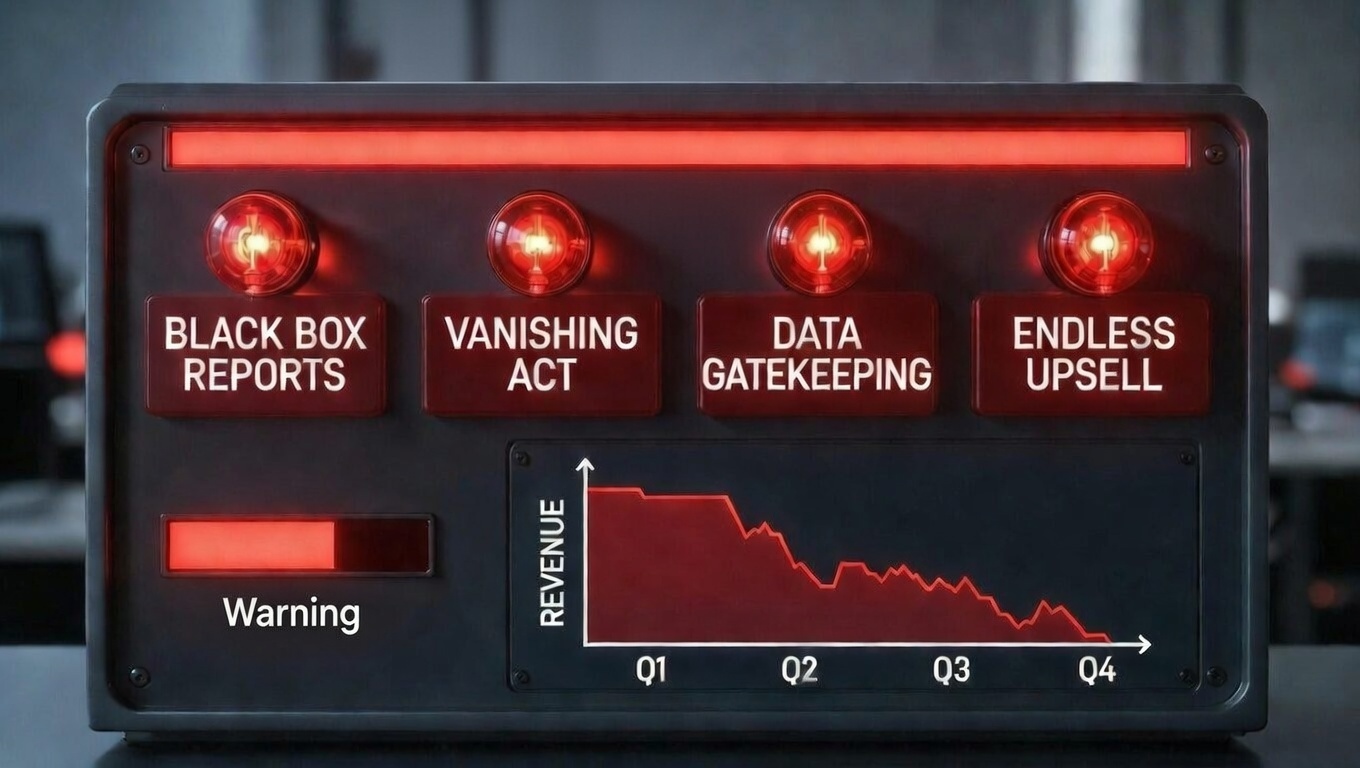
The "Black Box" Reporting
You get a PDF every month filled with impressions, clicks, and engagement rates. Graphs going up and to the right. Looks professional.
But when you ask, “How did this lead to actual sales?”… the answer gets fuzzy.
What it looks like:
- Reports heavy on vanity metrics (impressions, reach, clicks)
- Vague connections between activity and revenue
- “It’s complicated” as a frequent answer
- Data dumps without clear “so what” explanations
What it means: Either they don’t know how their work connects to your bottom line, or they don’t want you to know. Neither is acceptable.
The Vanishing Act
Remember the sales process? Responsive emails within hours. Call whenever you need them. Big ideas and enthusiasm.
Now? Three days to get a reply to a simple question.
What it looks like:
- Slow email response (48+ hours for routine requests)
- Difficulty scheduling calls
- Account manager changes without warning
- Feeling like you’re low priority
What it means: You’ve been “won” and deprioritized. The attention has shifted to new business acquisition.
Gatekeeping Your Data
This is the nuclear red flag: Your agency won’t give you administrative access to your own accounts.
If you don’t have ownership of your:
- Google Ads account
- Meta Business Suite
- Analytics properties
- Search Console
- Any platform where your money is spent
…your agency is holding your brand hostage. Whether intentional or “just how they set things up,” this creates leverage that benefits them, not you.
What it means: If you leave, you lose everything they’ve built. That’s a relationship built on dependency, not value.
The Endless Upsell
Every conversation about problems becomes a pitch for additional services.
Website not converting? You need their landing page package. Rankings not improving? You need their premium SEO add-on. Social engagement low? Time for their influencer program.
What it means: They may be more focused on expanding your contract than solving your actual problems.
The Green Flags: What Trustworthy Partners Do?
A genuine agency partner doesn’t just work for you—they work with you. Look for these traits:
Extreme Transparency
They tell you when things don’t work.
In digital marketing, not every experiment succeeds. A/B tests fail. Campaigns underperform. That’s normal. The difference is whether they tell you.
What it looks like:
- “This ad set didn’t perform. Here’s why we think that happened, and here’s how we’re pivoting.”
- Clear explanations of what they tested and learned
- No spin when results are disappointing
- Willingness to admit uncertainty
Focus on Your "North Star" Metrics
They measure what you care about, not what makes them look good.
If your goal is qualified leads, they don’t brag about likes. If your goal is revenue, they connect activities to sales. They speak the language of your business’s bottom line.
What it looks like:
- Reports organized around your stated objectives
- KPIs that match your actual business goals
- Clear attribution connecting marketing to outcomes
Proactive Strategy
They bring you ideas before you ask for them.
If you’re the one always suggesting the next move, always asking “what about this?” or “should we try that?”—you’re not paying for an agency. You’re paying for a task-taker.
What it looks like:
- Regular strategic recommendations
- Industry updates and how they apply to you
- Testing new approaches without being asked
- Challenging your assumptions when appropriate
Data Access and Education
They want you to understand what’s happening—and they give you the keys.
What it looks like:
- You own all accounts; they have partner/manager access
- Willingness to walk you through reports and answer questions
- Teaching you enough to evaluate their work
- Documentation that would allow a smooth transition if needed

How to Stress-Test (or Rebuild) the Relationship ?
If trust is shaky, you don’t necessarily need to fire them tomorrow. Try these steps first:
Step 1: Request a "Deep Dive"
Go beyond the monthly report. Schedule a call where they walk you through:
- The strategy behind recent decisions
- How specific activities connected to outcomes
- What’s working, what isn’t, and what they’re changing
- Their hypothesis for the next quarter
Pay attention to whether answers are confident and specific or vague and defensive.
Step 2: Audit Account Ownership
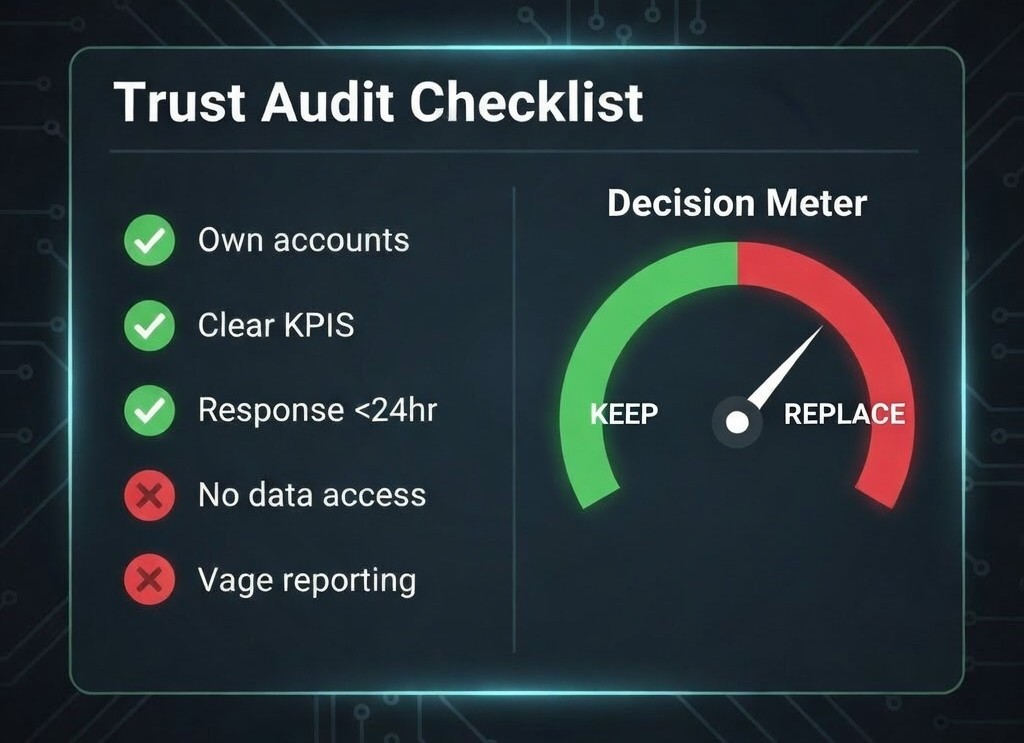
This is non-negotiable. Confirm:
- Your company owns all ad accounts, analytics properties, and platform profiles
- The agency has “partner” or “manager” access only
- You have admin access to everything
- Credentials are documented somewhere you control
If they push back on this, that tells you everything you need to know.
Step 3: Set Clear KPIs for the Next 90 Days
Re-align on what success looks like with specific, measurable milestones:
- “Increase qualified leads by 20%”
- “Reduce cost per acquisition by $X”
- “Improve conversion rate from 2% to 2.5%”
- “Generate X revenue attributed to campaigns”
If they can’t hit agreed-upon milestones, you have your answer. If they can’t even agree to measurable milestones, you have your answer faster.
Step 4: Get a Second Opinion
Consider having another agency or consultant audit your current campaigns. A fresh perspective might reveal issues you’ve normalized or opportunities you’ve missed.
When to Walk Away ?
Sometimes the relationship isn’t fixable. Consider leaving if:
- They refuse data access — This alone justifies immediate departure
- Results have stagnated for 6+ months — With no clear explanation or adjustment plan
- Trust has fundamentally broken — You find yourself double-checking everything
- Communication has collapsed — Getting their attention requires escalation
- Your business has outgrown them — What worked at $10K/month doesn’t work at $50K/month
Walking away is expensive and disruptive. But staying in a bad relationship is more expensive—you’re just paying in slower bleeding.
What a Trust-Based Agency Relationship Looks Like ?
Here’s what you should feel when the partnership is working:
Informed, not dependent: You understand enough to evaluate their work, even if you couldn’t do it yourself.
Confident, not anxious: Monthly reports feel like progress updates, not suspicious documents requiring forensic analysis.
Partnered, not managed: They bring strategy and ideas. You’re collaborating on growth, not assigning tasks.
Flexible, not locked in: You could leave anytime—but you don’t want to because they’re delivering value.
Trust shouldn’t be a leap of faith. It should be a calculated result of consistent performance and clear communication.
The Bottom Line
Your agency should feel like an extension of your team, not a line item you’re afraid to investigate.
If you find yourself:
- Constantly double-checking their work
- Unable to explain what they’re doing for you
- Surprised by invoices or unclear on deliverables
- Locked out of your own accounts
…you’re not in a partnership. You’re in a dependency. And in digital marketing, that’s an expensive way to spend your time and money.
The right agency earns your trust through transparency. They educate you. They give you access. They show their work. They celebrate wins honestly and acknowledge failures openly.
That’s the standard. Don’t settle for less.
How AI Marketing Technology Builds Trust ?
At AI Marketing Technology, trust is engineered into how we work:
Full Data Ownership: You own all accounts from day one. We have partner access. Your data is your data.
Transparent Reporting: Monthly reports connect activities to outcomes. No vanity metrics without context. Every number ties to your business goals.
Accessible Teams: Your questions get answers—usually within 24 hours, always from people who know your account.
Clear Deliverables: You know exactly what you’re getting, when you’re getting it, and how we’re measuring success.
No Hostage Situations: Our documentation means you could transition away smoothly. We stay because we’re delivering value, not because you’re stuck.
That’s not unusual—it’s how agency relationships should work.
Frequently Asked Questions
How do I know if my digital marketing agency is trustworthy? Look for: transparent reporting tied to business outcomes, proactive strategy recommendations, full access to your own accounts and data, responsive communication, and willingness to admit when things don’t work. Red flags include vague reporting, slow responses, data gatekeeping, and constant upselling.
Should I have admin access to my own ad accounts? Absolutely. You should own all accounts (Google Ads, Meta, Analytics, etc.) with the agency having partner or manager access. If your agency controls ownership, you’re dependent on them—and leaving means losing everything.
What should a good agency report include? Reports should show: metrics aligned to your stated goals, clear connections between activities and outcomes, performance vs. benchmarks (month-over-month, year-over-year), honest assessment of what’s working and what isn’t, and specific recommendations for next steps.
How often should I communicate with my agency? At minimum: monthly reporting calls with your account manager, quarterly strategic reviews with senior leadership, and prompt responses to questions (24-48 hours for routine inquiries, same-day for urgent issues). More frequent communication is fine if you’re in active campaign phases.
What’s a reasonable contract term with a marketing agency? Month-to-month or quarterly agreements are fairest for clients. Annual contracts can make sense for cost savings, but ensure there are performance-based exit clauses. Be wary of long-term commitments without clear deliverables and accountability.
When should I consider switching agencies? Consider switching when: results have stagnated with no clear explanation, trust has broken down despite attempts to repair it, communication consistently fails, they refuse to give you access to your own data, or your business needs have outgrown their capabilities.
Looking for a marketing partner you can actually trust? Contact AI Marketing Technology to discuss how we approach client relationships differently.
