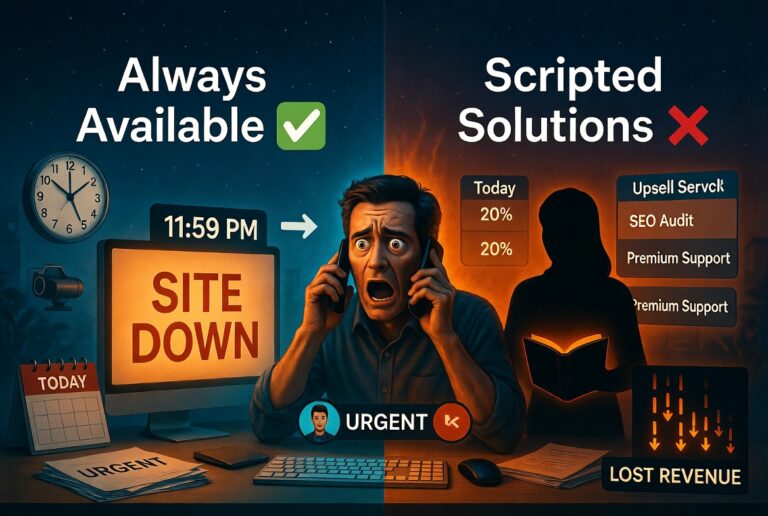
Here’s a question every small business owner has asked at 2 AM while staring at a crashed website: Does my hosting provider actually get what I’m going through right now?
GoDaddy has built an empire by being the “front door” to the internet for millions of businesses. They’ve got the catchy commercials, the Super Bowl ads, and the promise that anyone can get online in minutes.
But there’s a massive difference between availability and understanding.
Once you’re past that front door, the requirements change. You’re not just looking for a domain anymore—you’re looking for a partner who understands that your website going down at midnight isn’t an inconvenience. It’s lost revenue. It’s missed-opportunities. It’s your livelihood.
So let’s have an honest conversation about what large providers like GoDaddy get right, where they fall short, and what it means for your business.
The Power of "Always On" Support
Credit where it’s due: GoDaddy’s 24/7/365 support across phone, live chat, and even WhatsApp is genuinely impressive.
For a solopreneur or micro-business owner, this is a massive safety net. Many boutique hosting providers limit support to ticketing systems or strict business hours. If you’ve ever had a website emergency at midnight on a Saturday, you know the panic of realizing no one’s coming to help until Monday.
GoDaddy understands that small business owners don’t work 9-to-5. The ability to speak to an actual human during a late-night crisis is a competitive advantage that shouldn’t be overlooked.
But availability is only half the equation.
The Knowledge Gap vs. The Script
Here’s where things get complicated.
While GoDaddy excels at being available, the quality of that interaction is where many SMB owners feel a disconnect. The common frustration? The Scripted Wall.
As GoDaddy has scaled to serve millions of customers, their first-tier support has become highly standardized. For a basic password reset or DNS lookup, it works perfectly.
But SMBs rarely face basic problems.
Your issues look more like:
- A botched WordPress migration that broke half your plugins
- A DNS conflict with your third-party CRM
- Email sync failures that are costing you client communications
- SSL certificate nightmares that make Chrome warn visitors away
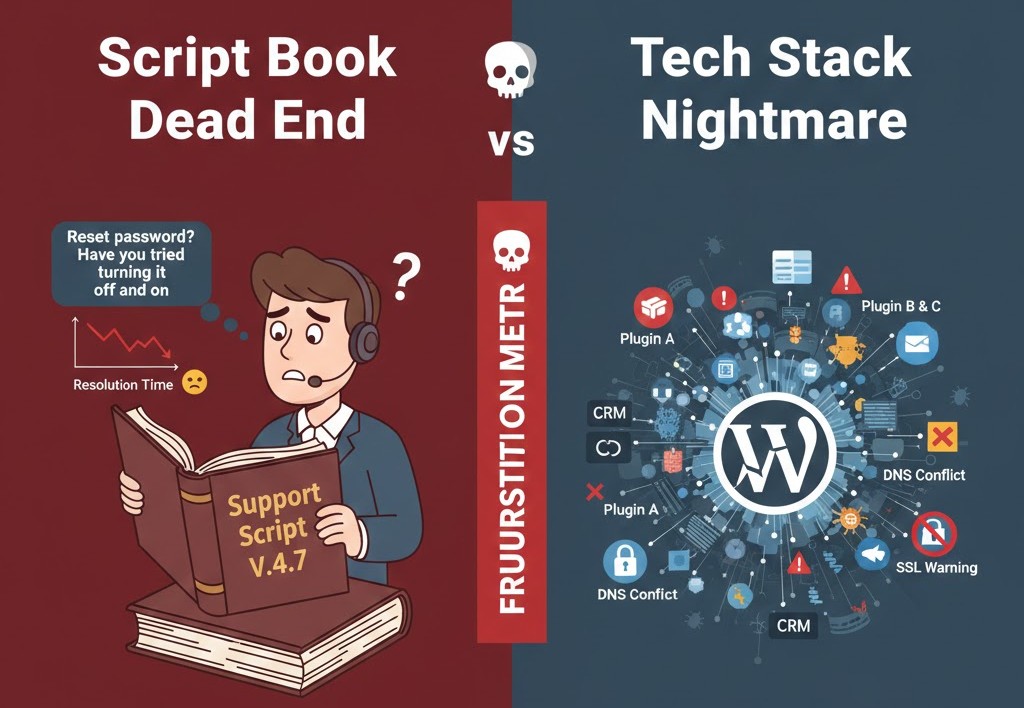
When a business owner encounters a support agent who can’t deviate from a pre-written manual, the interaction feels transactional rather than solution-oriented.
You’re not looking for someone to read troubleshooting steps off a screen. You need someone who understands the interconnected mess of a real small business tech stack.
The Upsell Fatigue Problem
Perhaps the biggest friction point in GoDaddy’s relationship with small businesses is their aggressive sales culture.
You call about a technical error. You’re frustrated. Your website is down. And within minutes, the conversation pivots to a pitch for “Premium SEO Services” or “Advanced Security Bundles.”
Small business owners are operating on razor-thin margins. When you’re calling for help with an urgent problem, the last thing you want is a cross-sell.
A company that truly understands SMBs knows that transparency and immediate fixes build more loyalty than any upsell ever could. Solve my problem first. Earn my trust. Then we can talk about what else you offer.
Where GoDaddy Actually Delivers ?
To be fair, GoDaddy has invested heavily in making things not break in the first place.
Their AI-driven tools (like the Airo platform) recognize that an SMB’s greatest deficit is time. By automating complex tasks—site backups, basic security patching, logo generation, and email setup—they aim to reduce the need for support calls entirely.
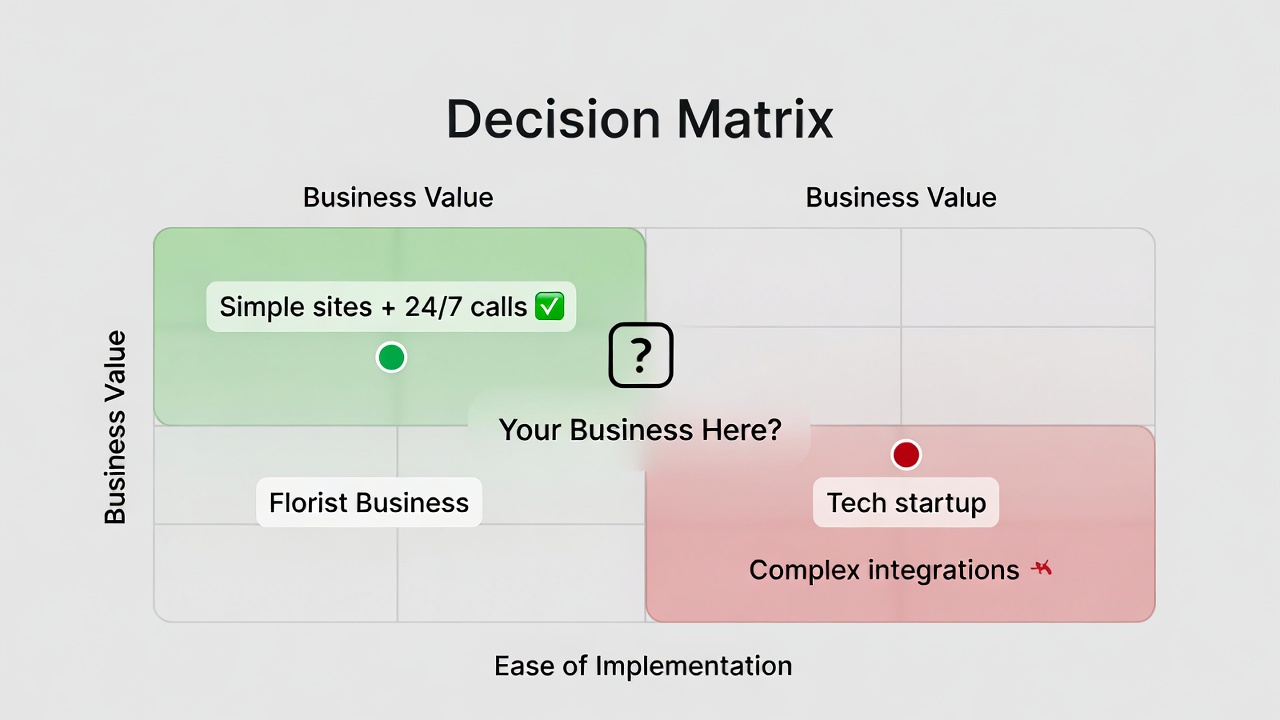
For a florist, a local plumber, or a neighborhood bakery who just needs things to “just work,” this proactive infrastructure is genuinely valuable. These business owners don’t want to become web developers. They want to run their businesses.
GoDaddy’s one-stop-shop model also has real advantages:
- Domain registration, hosting, email, and basic marketing in one place
- Simplified billing instead of juggling five vendors
- Templates and tools designed for non-technical users
If your needs are straightforward, this consolidation can be a genuine time-saver.
The Verdict: Do They Actually Get You?
The honest answer: Yes, but only to a certain scale.
GoDaddy understands the mechanics of small business needs:
- You need it affordable
- You need it fast
- You need someone to pick up the phone
They’ve built world-class infrastructure to handle the volume of small business demand.
However, they often struggle with the nuance of SMB support.
If your business requires:
- Technical customization beyond templates
- Complex integrations with third-party tools
- A dedicated account manager who knows your history
- Expert-level troubleshooting without scripts
…GoDaddy’s mass-market approach might feel cold.
Who Should Use GoDaddy ? (And Who Shouldn't)
GoDaddy Makes Sense If:
- You want a one-stop-shop — Domain, hosting, email, and basic marketing tools in one place
- You value phone support above all else — Being able to call someone at 3 AM matters to you
- Your needs are relatively standard — Brochure websites, simple e-commerce, basic email
- You want AI tools handling the heavy lifting — Automated backups, security, and maintenance
Look Elsewhere If:
- You need a technical partner — Deep troubleshooting, custom configurations, complex integrations
- Upselling bothers you — You want support conversations to stay focused on your problem
- You’ve outgrown templates — Your business needs solutions that don’t fit in pre-built boxes
- You need dedicated attention — An account manager who knows your business history
The Bigger Question: What Do You Actually Need?
Before evaluating any provider, get clear on your own requirements:
Availability vs. Expertise: Do you need someone available 24/7, or do you need someone who can solve complex problems during business hours?
Self-Service vs. Managed: Are you comfortable handling routine maintenance yourself, or do you need someone to handle everything?
Cost vs. Customization: Is the one-stop-shop discount worth the limitations, or would paying more for specialized services better serve your growth?
The right answer depends entirely on where your business is today—and where you’re headed tomorrow.
How AI Marketing Technology Approaches This Differently
At AI Marketing Technology, we built our support model around a simple premise: small businesses deserve expertise, not scripts.
Our approach includes:
Dedicated Support Teams — Real specialists who understand the complexity of integrated marketing technology, not first-tier generalists reading from manuals.
No Upsell Culture — When you contact us with a problem, we solve the problem. Period.
Proactive Monitoring — We identify and fix issues before they become emergencies—because we know you have a business to run.
Scalable Solutions — Tools that grow with you, from startup to established enterprise, without forcing you to switch providers.
The goal isn’t just to be available. It’s to be genuinely helpful.

Frequently Asked Questions
Is GoDaddy good for small businesses? GoDaddy is a solid choice for small businesses with straightforward needs—basic websites, email, and domain registration. Their 24/7 phone support and all-in-one platform offer convenience. However, businesses requiring technical customization or complex integrations may find their standardized support limiting.
Why does GoDaddy upsell so much during support calls? GoDaddy’s business model relies heavily on additional services beyond basic hosting. Their support representatives are trained to identify upsell opportunities. While this can be frustrating during urgent support calls, it’s a standard practice in their mass-market approach.
What’s the difference between GoDaddy and boutique hosting providers? GoDaddy offers scale, 24/7 availability, and an all-in-one platform at competitive prices. Boutique providers typically offer more personalized support, deeper technical expertise, and customized solutions—but often at higher price points and with limited support hours.
How do I know if I’ve outgrown GoDaddy? Signs you may need a more specialized provider include: frequent frustration with scripted support responses, needing custom server configurations, integrating complex third-party tools, or requiring dedicated account management. If you’re hitting limitations regularly, it’s time to evaluate alternatives.
Can I migrate away from GoDaddy easily? Yes, though it requires planning. Ensure you own your domain separately from hosting, back up all website files and databases, and document your current configuration. Many specialized providers offer migration assistance to simplify the transition.
What should I look for in an SMB hosting provider? Prioritize: expertise in your specific needs (e-commerce, professional services, etc.), transparent pricing without aggressive upsells, support staff who can handle complex issues, and a track record with businesses similar to yours. Availability matters, but expertise matters more.
Looking for marketing technology support that actually understands small business complexity? Contact AI Marketing Technology to learn how we approach things differently.
