
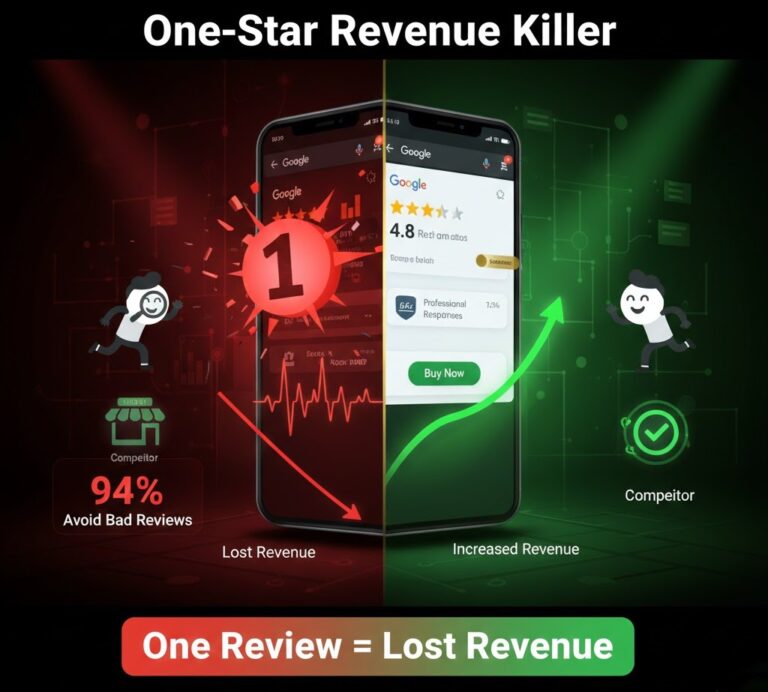
Here’s a statistic that should keep you up at night: 94% of consumers say a negative review has convinced them to avoid a business.
Not some of them. Not a few. Almost all of them.
That one-star review you’ve been ignoring? It’s not just hurting your feelings. It’s actively driving away customers who would have otherwise bought from you.
And the worst part? Most businesses only realize the damage after it’s already done.
Let’s talk about how online reviews actually affect your business—and what you can do about it before your competitors eat your lunch.
Why Online Reviews Matter More Than Ever ?
Reviews Are the New Word of Mouth
Think about the last time you tried a new restaurant, hired a service provider, or bought a product from an unfamiliar brand. What did you do first?
You read reviews.
You’re not alone. Before making almost any purchase decision, modern consumers:
- Check Google reviews
- Read Facebook and Instagram comments
- Look at marketplace ratings
- Search for Reddit discussions
- Watch YouTube reviews
Word of mouth never disappeared. It just moved online—and became permanent.
First Impressions Happen Before You Ever Meet
Here’s what most businesses don’t fully grasp: reviews often form the first impression of your business.
A potential customer searches for what you offer. They see your listing alongside competitors. They immediately notice your star rating and review count.
In that split second, they’ve already decided whether to click on your business or scroll past.
A 4.5-star rating with 200 reviews says “established and trusted.” A 3.2-star rating with 15 reviews says “probably should look elsewhere.”
How Bad Reviews Actually Kill Your Business ?
The Trust Destruction
Negative reviews plant seeds of doubt—even in customers who were ready to buy.
What customers think when they see bad reviews:
Bad Review Pattern | Customer Assumption |
“Poor service” complaints | “They don’t care about customers” |
“Product quality” issues | “Not worth the price” |
“No response” from business | “They won’t help if I have problems” |
“Slow delivery” mentions | “Unreliable, might be late” |
Multiple recent negatives | “Something’s going wrong here” |
Even if those reviews don’t accurately represent your business, the perception becomes reality for potential customers.
The Revenue Math
Let’s make this concrete.
Imagine you get 1,000 potential customers considering your business each month. With a strong review profile:
- 70% choose to engage → 700 potential customers
- 10% convert → 70 sales
With a weak review profile:
- 40% choose to engage → 400 potential customers
- 10% convert → 40 sales
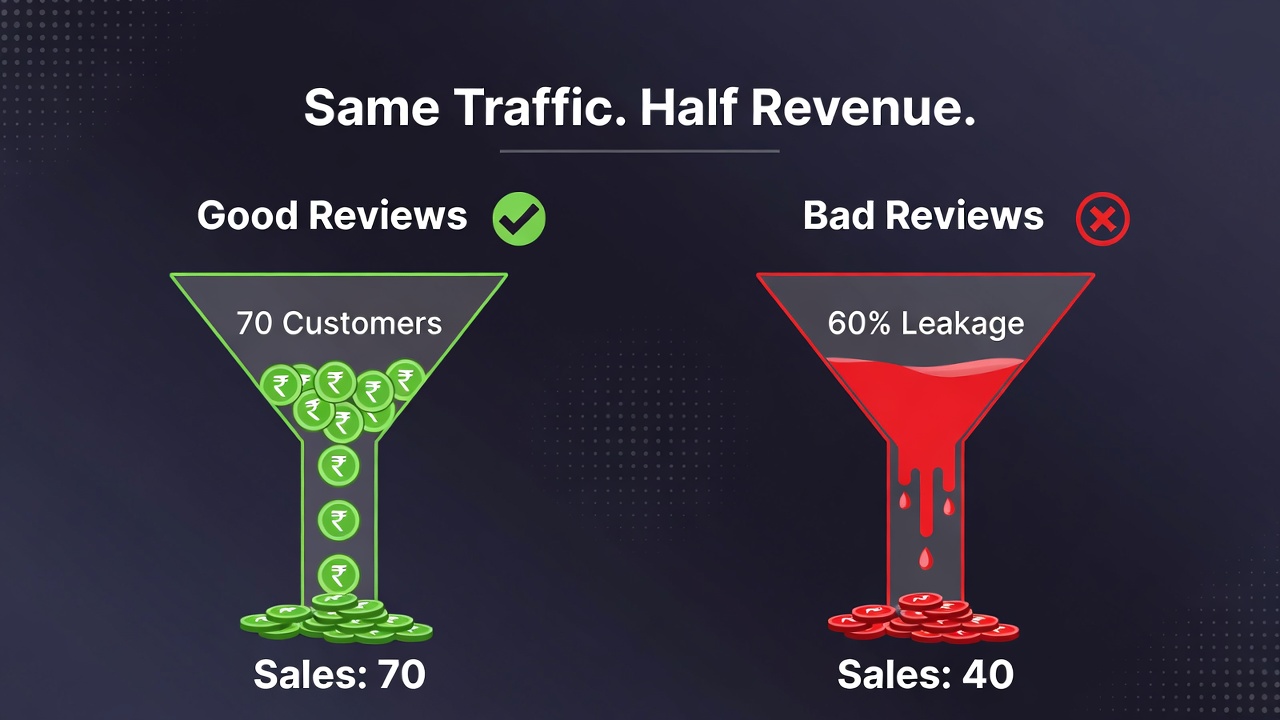
Same traffic. Same product. Same prices. Nearly half the revenue.
That’s what bad reviews cost you—and it compounds every single month.
The SEO Damage
Bad reviews don’t just hurt perception. They hurt visibility.
How reviews affect search rankings:
- Google considers review quantity and quality for local rankings
- Businesses with higher ratings appear more prominently in local packs
- Click-through rates drop for lower-rated businesses (which further hurts rankings)
- Less visibility → less traffic → fewer customers → fewer reviews → a downward spiral
Your competitors with better reviews aren’t just more trusted—they’re more visible.
The Mistakes That Make Things Worse
Mistake #1: Ignoring Negative Reviews
The worst thing you can do with a bad review? Nothing.
Why silence is deadly:
- Customers assume the complaint is valid
- It signals you don’t care about problems
- The issue remains public without context or resolution
- Other dissatisfied customers feel empowered to pile on
Every unanswered negative review tells potential customers: “We won’t help you if something goes wrong.”
Mistake #2: Responding Defensively
The second-worst thing? Getting into an argument.
Responses that backfire:
- “That’s not what happened” (calling the customer a liar)
- “This isn’t our fault” (refusing accountability)
- “You should have read the policy” (blaming the customer)
- Any response written in anger or frustration
Remember: you’re not writing to convince the reviewer. You’re writing for the thousands of people who will read your response later.
A defensive response often does more damage than the original review.
Mistake #3: Fake Reviews
Some businesses try to bury negatives with fake positives. This is a terrible strategy:
- Platforms are getting better at detecting fake reviews
- Penalties include removal of all reviews or account suspension
- Customers can often spot inauthenticity
- It doesn’t address the underlying issues causing bad reviews
Turning Bad Reviews Into Opportunities
The Right Way to Respond
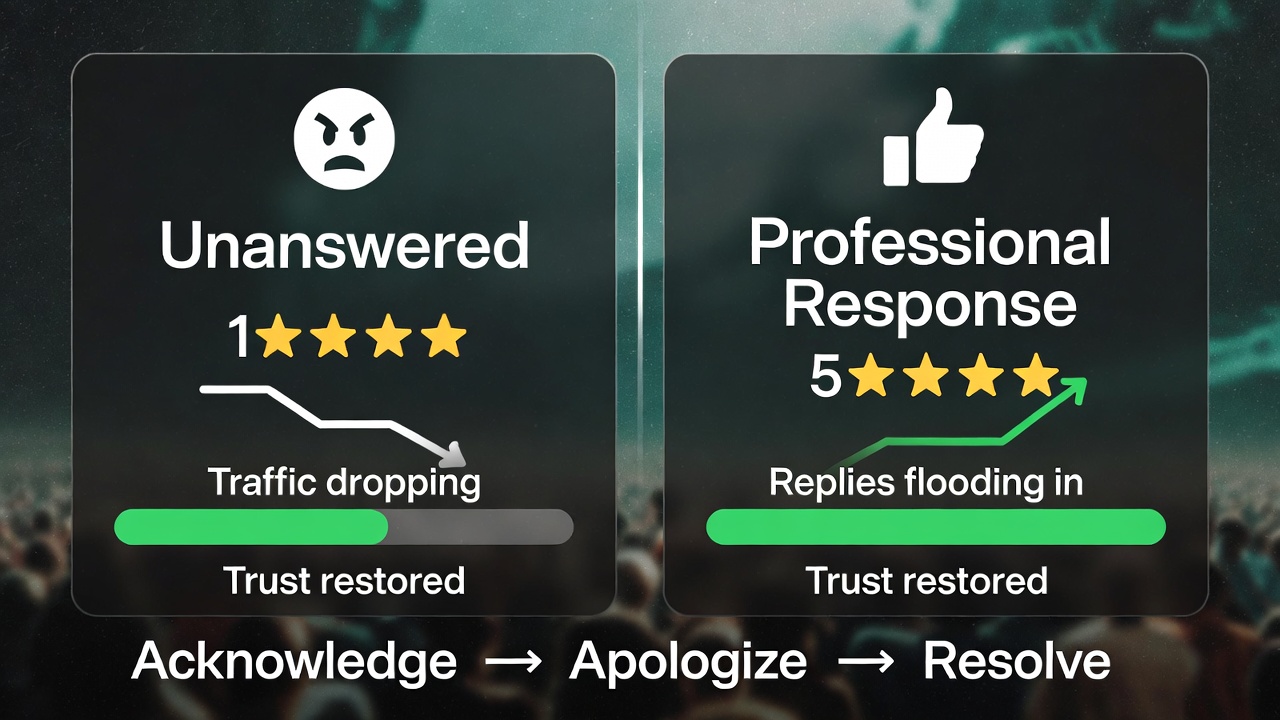
A professional response to a negative review can actually improve your reputation. Here’s the formula:
- Acknowledge the issue “Thank you for your feedback. We’re sorry to hear about your experience.”
- Apologize appropriately “We apologize that we didn’t meet your expectations.”
- Offer to resolve offline “We’d like to make this right. Please contact us at [email/phone] so we can address this directly.”
- Keep it brief Don’t write an essay. A few sentences is enough.
What this communicates to future customers:
- You monitor feedback and care about it
- You take responsibility when things go wrong
- You’re willing to fix problems
- You’re professional and mature
The Power of More Positive Reviews
Here’s the reality: you can’t delete most negative reviews. But you can dilute their impact with positive ones.
If you have 50 reviews averaging 4.0 stars, and you add 50 more averaging 4.8 stars, your overall rating jumps significantly.
The math works in your favor—but only if you actively collect positive reviews.
Ethical Ways to Generate Reviews
Method | How It Works | Effectiveness |
Post-purchase requests | Email or SMS asking for feedback | High |
Direct asks | Verbal request after positive interaction | Very high |
QR codes | In-store or on receipts linking to review page | Medium |
Follow-up messages | WhatsApp or SMS after service completion | High |
Review links | Make it one-click easy to leave reviews | Medium-high |
The key principle: Make leaving a review effortless for happy customers.
Building a Review Management System
Monitor Continuously
You can’t respond to reviews you don’t know about.
Set up monitoring for:
- Google Business Profile
- Facebook page
- Industry-specific platforms
- Social media mentions
- Any marketplace where you sell
Tools that help: Google Alerts, social listening platforms, reputation management software.
Respond Quickly
Speed matters. A response within 24 hours shows you’re attentive. A response after a week shows you barely noticed.
Response time guidelines:
- Negative reviews: Within 24 hours (ideally same day)
- Positive reviews: Within 48 hours
- Questions in reviews: As quickly as possible
Learn From Feedback
Reviews are free customer research. If multiple customers mention the same issue, you have a systemic problem worth fixing.
Common patterns to watch for:
- Customer service complaints → Train your team
- Product quality issues → Address with suppliers
- Delivery problems → Review logistics partners
- Communication gaps → Improve your processes
Fixing the root cause prevents future negative reviews.
Protecting Your Reputation Long-Term
Consistency Is Prevention
The best review management strategy? Consistently excellent service that prevents complaints in the first place.
Focus areas:
- Staff training on customer service
- Clear communication at every touchpoint
- Setting appropriate expectations
- Following through on promises
- Making it easy to resolve issues before they become reviews
Transparency Builds Trust
Sometimes things go wrong. How you handle it matters more than the mistake itself.
Transparency that builds trust:
- Admitting errors instead of making excuses
- Proactively communicating delays or problems
- Offering fair resolutions without being asked
- Following up to ensure satisfaction
Customers don’t expect perfection. They expect honesty and effort.
The Bottom Line
Your online reputation isn’t a vanity metric. It’s a business asset—or a business liability.
Bad reviews don’t have to kill your business. But ignoring them might.
The businesses that thrive in 2026 aren’t the ones with zero negative reviews (those don’t exist). They’re the ones who:
- Respond professionally to every review
- Actively collect positive reviews
- Fix problems that cause complaints
- Treat their reputation as a strategic priority
Your competitors are paying attention to this. Are you?
Frequently Asked Questions
Do bad reviews really affect business growth? Yes, significantly. Studies show that negative reviews reduce trust, lower conversion rates, hurt search rankings, and drive customers to competitors. The cumulative effect can devastate revenue over time.
Should businesses respond to every bad review? Yes. Every negative review is an opportunity to demonstrate professionalism and willingness to resolve issues. Your response is read by far more potential customers than the original reviewer.
Can a business recover from bad reviews? Absolutely. With prompt professional responses, improved service, and consistent collection of positive reviews, businesses can rebuild their reputation. The key is taking action rather than hoping the problem goes away.
How many bad reviews are too many? There’s no magic number, but patterns matter more than individual reviews. A single negative among fifty positives is normal. Multiple recent negatives signal a problem requiring immediate attention.
What’s the best way to prevent bad reviews? Deliver consistently excellent service, communicate clearly, and make it easy for customers to resolve issues directly with you before turning to public reviews. Most negative reviews are preventable with better processes.
Should I ask customers to remove negative reviews? You can ask politely if you’ve genuinely resolved their issue, but never pressure or incentivize removal. Focus instead on earning positive reviews that naturally push negatives down in prominence.
Struggling to manage your online reputation? AI Marketing Technology offers AI-powered review management that helps you monitor, respond, and build a five-star presence.
