Here’s a question that sounds outdated but isn’t: “Does my business really need to sell online?”
In 2026, asking this is like asking “Does my business really need a phone number?” The answer seems obvious—but the surprising reality is that millions of businesses still operate without any e-commerce presence.
They’re leaving money on the table. Lots of it.
Let me explain why selling online isn’t just a nice-to-have anymore—it’s the difference between thriving and slowly becoming irrelevant.
What E-Commerce Actually Means Today ?
Let’s clarify something: e-commerce isn’t just “having a website.”
E-commerce means any transaction that happens digitally. That includes:
- Traditional online stores (Shopify, WooCommerce)
- Social selling (Instagram shops, Facebook marketplace)
- Mobile commerce (in-app purchases, mobile-optimized stores)
- D2C brands selling directly to consumers
- B2B platforms selling to other businesses
- Subscription services and recurring purchases
If money changes hands through a digital channel, that’s e-commerce. And it’s happening everywhere.
The E-Commerce Models
Model | What It Means | Example |
B2C | Business to Consumer | Retail stores selling to individuals |
B2B | Business to Business | Wholesale suppliers, SaaS companies |
D2C | Direct to Consumer | Brands bypassing retailers |
C2C | Consumer to Consumer | Marketplace sellers on OLX, eBay |
Every business—regardless of size or industry—fits somewhere in this landscape.
The Reach Problem (And How E-Commerce Solves It)
Geography Used to Define Your Market
A decade ago, your potential customers were limited by how far they could travel to reach you. A retail store in Pune served customers in Pune. A service provider in Chennai worked with Chennai clients.
E-commerce erases those boundaries.
Today, the same businesses can:
- Serve customers nationally (or globally)
- Operate 24/7 without physical presence
- Reach underserved markets that lack local options
- Scale without proportional real estate costs
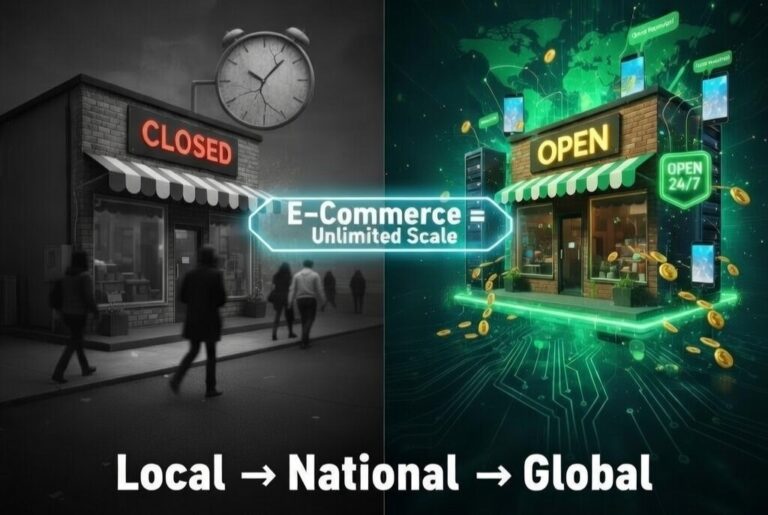
The 24/7 Store That Never Closes
Your physical store closes at night. Your employees go home. The phone stops ringing.
Your online store? It’s taking orders at 3 AM while you sleep.
This isn’t a small advantage. Think about how often you shop outside business hours—browsing products at night, making purchases on Sunday mornings, ordering during lunch breaks.
Your customers do the same. An e-commerce presence captures sales that would otherwise go to competitors who are “open” when you’re closed.
The Cost Advantage Most Businesses Ignore
“But e-commerce is expensive to set up,” you might think.
Let’s compare the actual numbers.
E-Commerce vs. Physical Expansion
Cost Factor | Physical Store | E-Commerce Store |
Setup costs | ₹5-50 lakhs+ | ₹5,000-50,000 |
Monthly rent | ₹20,000-2,00,000+ | ₹1,000-10,000 platform fees |
Staff required | Multiple employees | Can start solo |
Inventory display | Limited by space | Unlimited catalog |
Geographic reach | Local only | National/Global |
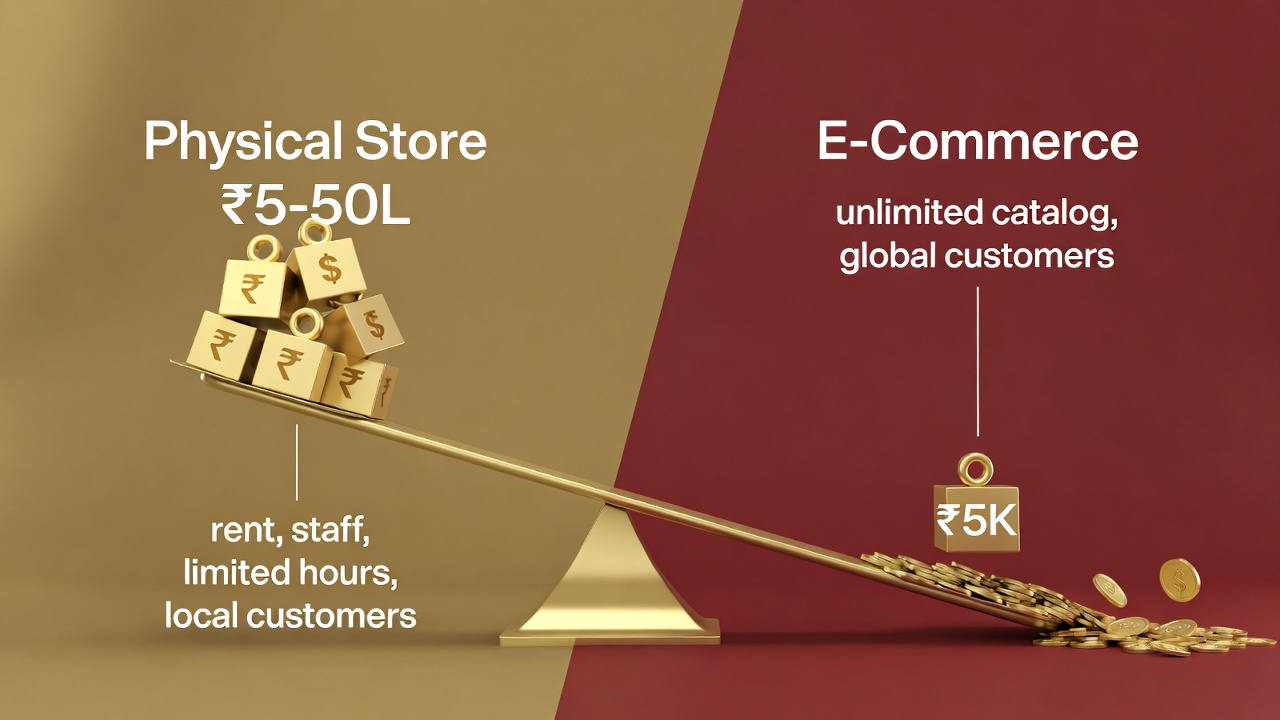
The math isn’t even close.
Scalability Without Proportional Costs
Here’s what traditional business expansion looks like:
- Want to serve more customers? Open another location.
- More locations mean more rent, more staff, more headaches.
- Growth becomes expensive and complicated.
Here’s what e-commerce expansion looks like:
- Want to serve more customers? Your existing store handles them.
- Increase server capacity slightly if needed.
- Growth becomes more profitable, not more complicated.
The Customer Experience Revolution
Modern customers expect convenience. E-commerce delivers it.
Personalization at Scale
Your physical store treats every customer the same. Your online store can treat every customer as an individual.
E-commerce personalization includes:
- Product recommendations based on browsing history
- Personalized email offers based on past purchases
- Dynamic pricing and promotions for different segments
- Customized shopping experiences for returning visitors
This isn’t creepy surveillance—it’s relevance. Customers appreciate seeing products they actually want instead of generic catalogs.
Flexibility That Customers Demand
Customer Expectation | E-Commerce Delivers |
Multiple payment options | UPI, cards, wallets, BNPL, COD |
Delivery choices | Express, standard, pickup options |
Easy returns | Clear policies, convenient process |
24/7 availability | Shop anytime, anywhere |
Product information | Detailed specs, reviews, comparisons |
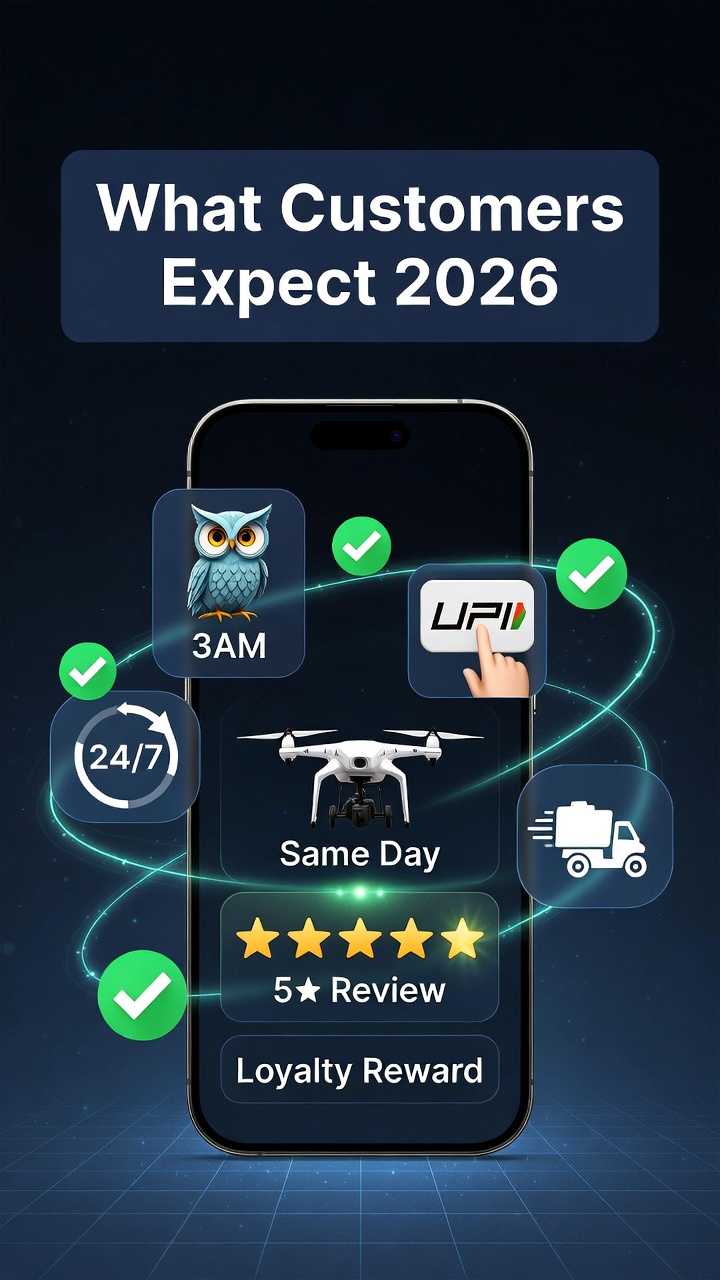
The businesses that meet these expectations win. The ones that don’t, lose customers to those that do.
Data: The Hidden Goldmine
Here’s something physical stores can never match: real-time business intelligence.
What E-Commerce Data Reveals ?
- Which products are people looking at but not buying?
- At what point in checkout do customers abandon carts?
- Which marketing channels bring the most valuable customers?
- What times and days generate the most sales?
- Which customer segments have the highest lifetime value?
This data transforms decision-making. Instead of guessing what customers want, you know.
Marketing That Actually Works
Traditional advertising is spray and pray. You put up a billboard and hope the right people see it.
Digital marketing is precision targeting:
- Show ads only to people likely to buy
- Retarget visitors who showed interest but didn’t purchase
- A/B test different approaches and double down on winners
- Track exact return on every marketing rupee spent
The result? Better returns on smaller budgets.
Building Trust and Loyalty Online
“But customers can’t touch my products online,” you might argue.
True. But trust signals have evolved.
What Builds Online Trust ?
- Customer reviews and ratings — Social proof from real buyers
- Secure payment badges — Security reassurance at checkout
- Clear policies — Transparent returns, shipping, and guarantees
- Professional design — First impressions matter
- Responsive support — Quick answers to questions
Retention Beats Acquisition
Acquiring new customers is expensive. E-commerce keeps them profitable.
Effective retention strategies:
- Loyalty and rewards programs
- Email marketing with personalized offers
- Subscription models for recurring revenue
- WhatsApp updates on new arrivals and promotions
- Exclusive deals for existing customers
A customer database that you own and can market to directly is one of the most valuable assets any business can build.
Competitive Advantage (Or Survival)
Let’s be blunt: your competitors are online.
If they’re selling online and you’re not:
- They’re capturing customers you could have reached
- They’re building brand awareness while you stay local
- They’re gathering data that improves their business
- They’re growing while you’re standing still
Future-Proofing Your Business
Consumer behavior is shifting online permanently. E-commerce isn’t a trend—it’s the new normal.
Trends accelerating this shift:
- Mobile-first shopping becoming dominant
- AI-driven personalization raising customer expectations
- Social commerce blurring shopping and browsing
- Voice commerce emerging as a new channel
- Same-day delivery becoming standard
Businesses that adapt now will lead. Those that resist will struggle to catch up.
Getting Started: It's Easier Than You Think
If you’ve been hesitant about e-commerce, here’s the reality: the barriers are gone.
- No technical skills required — Platforms handle the complexity
- Minimal upfront investment — Start for less than a dinner out
- Flexible scaling — Begin small and grow with demand
- Support available — Countless resources to help you succeed
The only barrier left is the decision to start.
The Bottom Line
E-commerce isn’t a separate strategy. It’s how business works now.
Every day without an online presence is a day of missed opportunities—customers you could have reached, sales you could have made, data you could have gathered.
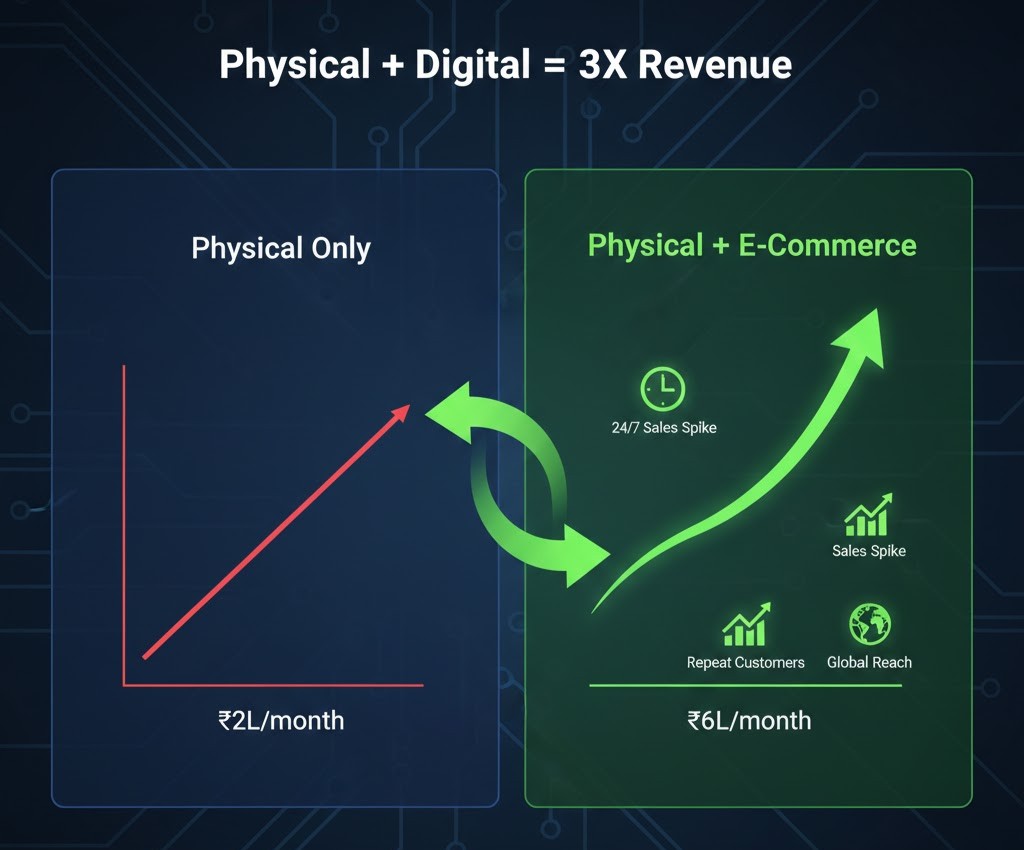
Your physical store doesn’t have to disappear. But it needs a digital partner. The businesses thriving in 2026 have both, working together.
The question isn’t whether e-commerce is right for your business.
The question is: how much longer can you afford to wait?
Frequently Asked Questions
Is e-commerce important for small businesses? Absolutely. E-commerce levels the playing field, allowing small businesses to reach more customers, reduce operational costs, and compete with larger brands. The percentage gains for small businesses adopting e-commerce often exceed what large companies see.
Can traditional brick-and-mortar businesses benefit from e-commerce? Yes. The most successful retailers today operate both physical and online stores. Your physical presence builds trust; your online store extends reach. They complement each other rather than compete.
Is e-commerce expensive to set up? Not anymore. Modern platforms allow you to launch a functional online store for less than ₹10,000. Costs scale with your business—you can start small and invest more as revenue grows.
How does e-commerce improve customer experience? E-commerce offers convenience (24/7 availability), personalization (relevant recommendations), flexibility (multiple payment and delivery options), and information (detailed product data and reviews). Customers increasingly expect these experiences.
What industries benefit most from e-commerce? Virtually all industries benefit. Retail and fashion lead, but education (online courses), healthcare (telemedicine), food (delivery), services (booking systems), and B2B (procurement platforms) are all being transformed by e-commerce.
Do I need to choose between physical and online selling? No. The most resilient businesses operate across multiple channels. Use your physical store for experience and trust-building while your online store captures convenience-seeking customers and extends your geographic reach.
Ready to bring your business online? AI Marketing Technology provides complete e-commerce solutions—from store setup to marketing automation—that get you selling faster.
