
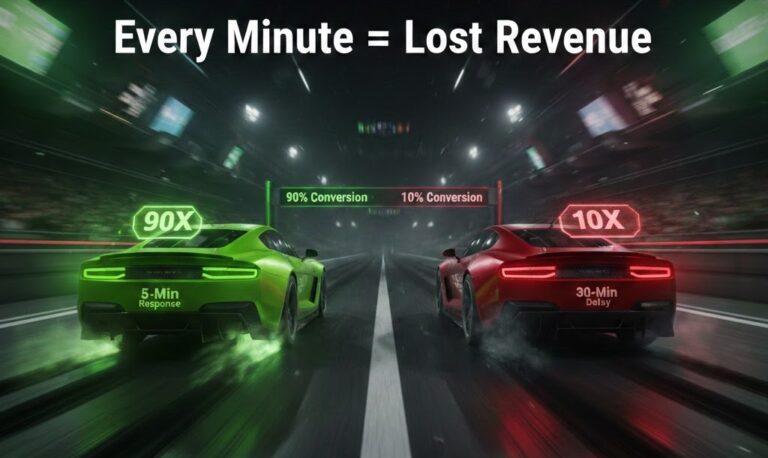
Here’s a number that should make you uncomfortable: the difference between responding to a lead in 5 minutes versus 30 minutes can mean a 9x difference in your chances of qualifying that lead.
Nine times. Not 9%. Nine times.
In an era where we obsess over optimizing everything—ad copy, landing pages, email subject lines—lead response time remains shockingly neglected. Businesses spend thousands acquiring leads, then let them sit for hours. Sometimes days.
It’s like buying groceries and leaving them on the porch to rot.
Speed isn’t a nice-to-have in lead response. It’s the difference between winning and losing customers.
Understanding Lead Response Time
Let’s define what we’re talking about.
Lead response time is the duration between a prospect expressing interest and your business making first contact. The clock starts the moment someone:
- Submits a contact form
- Requests a demo
- Downloads a resource
- Starts a chat
- Sends an inquiry email
Every minute that passes after that moment, your chances of connecting with that lead—and eventually converting them—drops.
Why Minutes Matter
Think about what’s happening in the prospect’s mind when they reach out:
- They have a problem that’s top of mind right now
- They’re actively researching solutions
- They’re probably reaching out to multiple companies
- Their attention is focused, but it won’t stay that way
Delay your response, and you’re not just being slow. You’re ceding ground to competitors who are faster
The Data Is Brutal (In a Helpful Way)
This isn’t an opinion. It’s backed by extensive research.
Response Time Benchmarks
Response Time | Impact on Qualification |
Within 5 minutes | Optimal—up to 9x better odds |
5-30 minutes | Still viable, but declining |
After 30 minutes | Dramatically reduced |
After 1 hour | Major damage to conversion potential |
After 24 hours | Effectiveness drops by 60%+ |
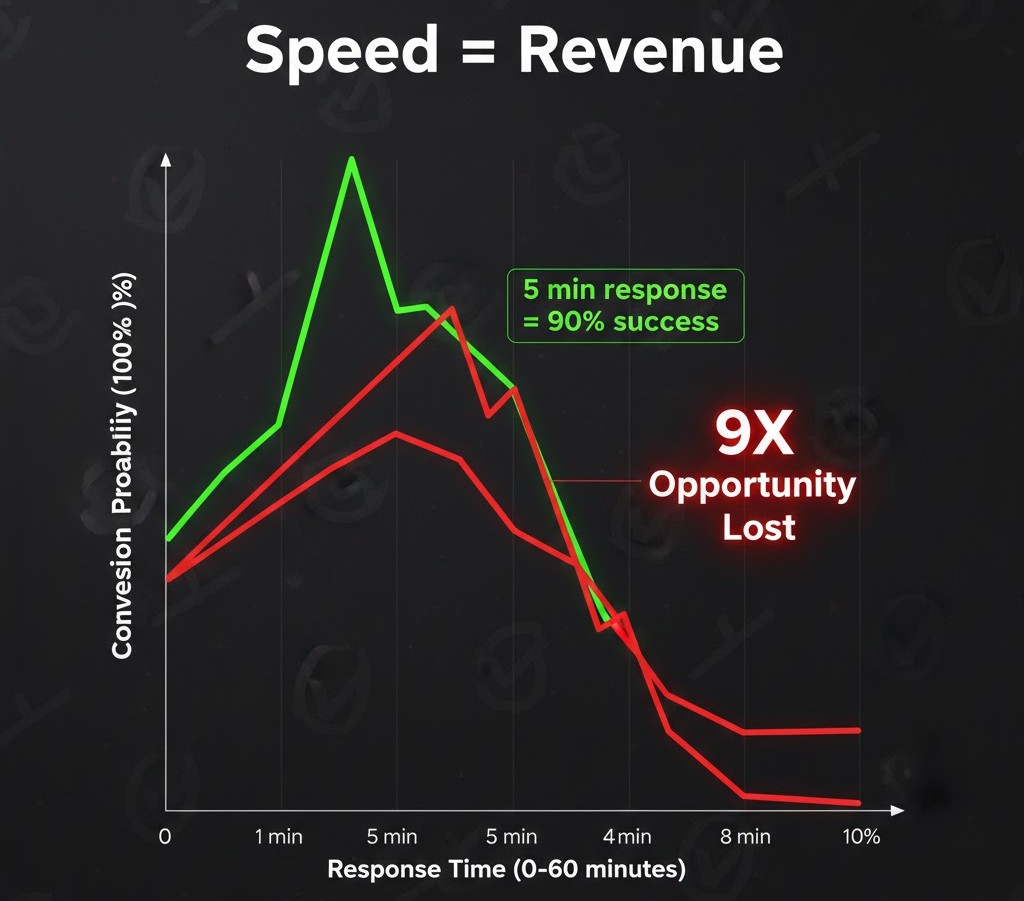
The pattern is clear: speed correlates directly with success.
One study found that leads contacted within 5 minutes are 100x more likely to be reached than those contacted after 30 minutes. Not slightly more likely—100 times more likely.
The Psychology Behind Immediate Response
Understanding why speed matters so much helps you appreciate just how critical this is.
Peak Intent
When someone reaches out, they’re in an active decision-making mindset. They’re thinking about their problem. They’re evaluating solutions. Their brain is engaged.
An hour later? They’ve moved on to something else. The urgency has faded. The context has shifted.
Momentum and Commitment
Reaching out to a business takes a small act of commitment. The prospect has invested mental energy. Fast response capitalizes on that momentum.
Slow response lets momentum dissipate. By the time you contact them, they have to remember why they reached out, re-engage with the problem, and decide if it’s still a priority.
Trust Signals
Here’s something subtle but powerful: response speed signals what it will be like to work with you?
Fast response communicates:
- “We’re organized.”
- “We value your time.”
- “We’re eager to help.”
- “We pay attention.”
Slow response communicates the opposite. Even subconsciously, prospects judge your entire business by how quickly you engage.
What Happens When You're Too Slow
The consequences of delayed lead response are tangible:
Lost Revenue
Every delayed response increases the probability that:
- The lead contacts a competitor (who responds faster)
- The lead loses interest as urgency fades
- The inquiry falls through the cracks entirely
- The problem gets solved another way
For high-value leads, we’re not talking about losing a few dollars. We’re talking about significant revenue walking away.
Damaged Brand Perception
Slow responses communicate things you don’t want to communicate:
- Internal disorganization
- Lack of customer focus
- Operational inefficiency
- Low prioritization of new business
Compare that to competitors who respond instantly. Which business feels more professional? Which one would you rather work with?
Wasted Marketing Spend
This is the one that hurts most strategically.
You’ve spent money acquiring that lead. Ad spend. Content creation. SEO work. The lead finally converts from visitor to prospect—and then you drop the ball by waiting too long.
Slow lead response is, effectively, throwing away your marketing investment.
Technology That Enables Speed
The good news: you don’t need superhuman response times from your team. Technology handles most of it.
CRM and Automation Systems
Modern CRM platforms transform lead response:
- Automatic lead routing to the right salesperson instantly
- Triggered email or SMS responses the moment a form is submitted
- Real-time alerts on mobile devices for high-priority leads
- Response time tracking so you can measure and improve
With proper automation, a lead can receive personalized acknowledgment within seconds—before a human even sees the notification.
AI Chatbots and Real-Time Messaging
AI-powered chat tools provide:
- 24/7 availability regardless of business hours
- Instant responses to common questions
- Lead qualification in real-time
- Automated scheduling for follow-up calls
This means leads never wait. Even at 2 AM on a Sunday, someone (or something) is there to engage.
The Hybrid Approach
The most effective system combines automation and human follow-up:
- Immediate automated response acknowledges the inquiry
- Lead routing ensures the right person is notified
- Human follow-up happens within minutes, not hours
- Nurturing sequences continue engagement if immediate connection fails
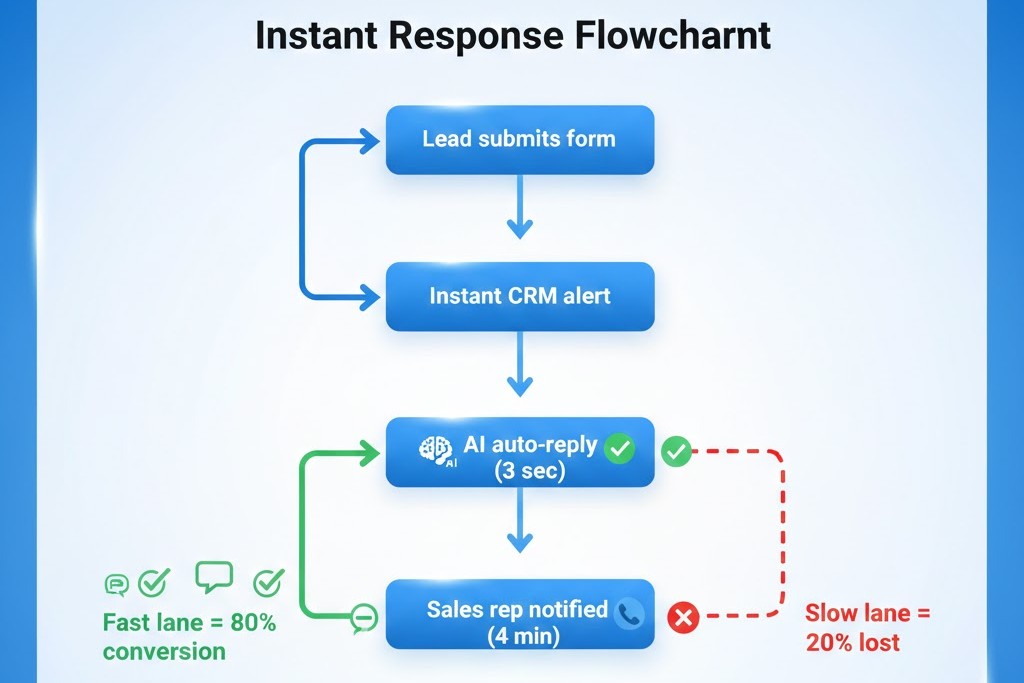
Automation ensures speed. Humans provide personalization. Together, they maximize conversion.
Building a Fast-Response Culture
Technology alone isn’t enough. Culture matters too.
Set Clear SLAs
Define expectations explicitly:
- New leads contacted within 5 minutes during business hours
- After-hours leads contacted within 15 minutes of the next business day
- High-priority leads (demo requests, pricing inquiries) escalated immediately
What gets measured gets managed. Track response times and hold teams accountable.
Align Sales and Marketing
Fast response requires coordination:
- Marketing needs to deliver qualified leads (not noise)
- Sales needs to be ready and responsive when leads arrive
- Both teams need visibility into what’s working and what’s not
Breakdowns between teams create delays. Alignment eliminates them.
Remove Friction
Identify anything slowing response:
- Too many steps before someone can reply?
- Unclear ownership of incoming leads?
- Notifications that get buried or ignored?
- Manual processes that could be automated?
Every point of friction is a potential delay. Eliminate them systematically.
Long-Term Benefits of Speed
Fast lead response isn’t just about individual conversions. It creates compounding advantages.
Higher Conversion Rates
Obvious, but worth emphasizing. Faster response = more qualified conversations = more closed deals = more revenue.
Shorter Sales Cycles
When you engage leads at peak interest, decisions happen faster. You’re not fighting to re-engage cold prospects—you’re capitalizing on warm ones.
Stronger Customer Relationships
First impressions matter. Leads who experience fast, helpful responses start the relationship with trust. That goodwill carries into the customer experience.
Higher Lifetime Value
Customers who had positive initial experiences tend to stick around longer, buy more, and refer others. Speed sets the foundation for relationships that last.
The Implementation Playbook
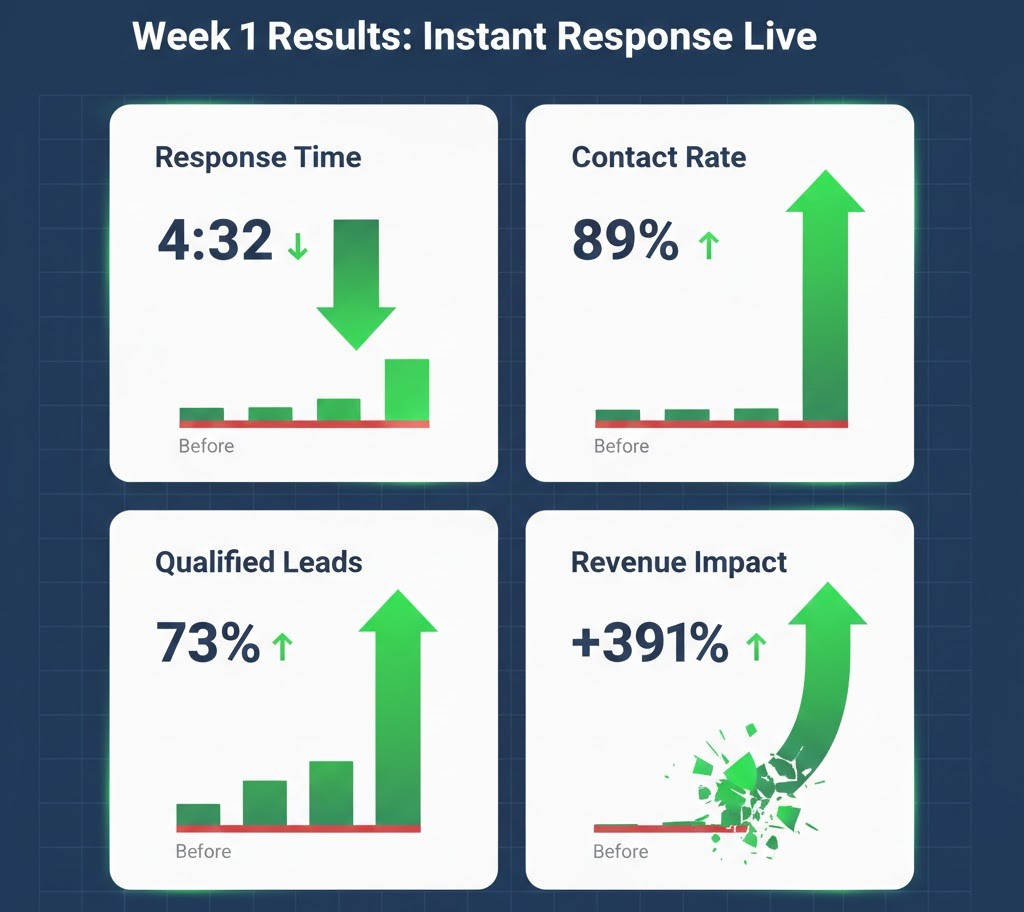
Ready to fix your lead response time? Here’s where to start:
- Measure current response time. You can’t improve what you don’t track. Baseline your current performance.
- Implement instant acknowledgment. Automated email or SMS confirming receipt of the inquiry.
- Set up real-time alerts. Make sure the right people know immediately when leads arrive.
- Define response SLAs. Clear expectations, documented and tracked.
- Consider AI chat. 24/7 coverage ensures leads never wait.
- Review weekly. Response time should be a regular metric in your sales and marketing reviews.
Frequently Asked Questions
What is the ideal lead response time? The optimal response time is within 5 minutes of lead submission. This dramatically increases your chances of connecting with the prospect and qualifying the opportunity.
Does immediate response really increase sales? Yes, significantly. Research consistently shows that faster responses lead to higher contact rates, better qualification rates, and more closed deals. The data is unambiguous.
How can small businesses respond to leads instantly? By leveraging automation: CRM auto-responders, email confirmation sequences, chatbots, and mobile push notifications for new leads. These tools are affordable and require minimal setup.
Is automation better than human response? Ideally, both. Automation ensures immediate acknowledgment and 24/7 availability. Human follow-up provides personalization and relationship-building. The hybrid approach outperforms either alone.
What happens if leads are contacted too late? Delayed responses result in lower engagement, reduced conversion rates, and lost competitive advantage. Many leads will have already engaged with competitors or moved on entirely.
How do I handle leads that come in after hours? Automated acknowledgment (“Thanks for reaching out—we’ll contact you first thing tomorrow”) combined with AI chat for common questions. First-thing-morning follow-up should be a priority.
Want to ensure no lead ever waits for your business? AI Marketing Technology builds intelligent response systems that convert leads 24/7.
