
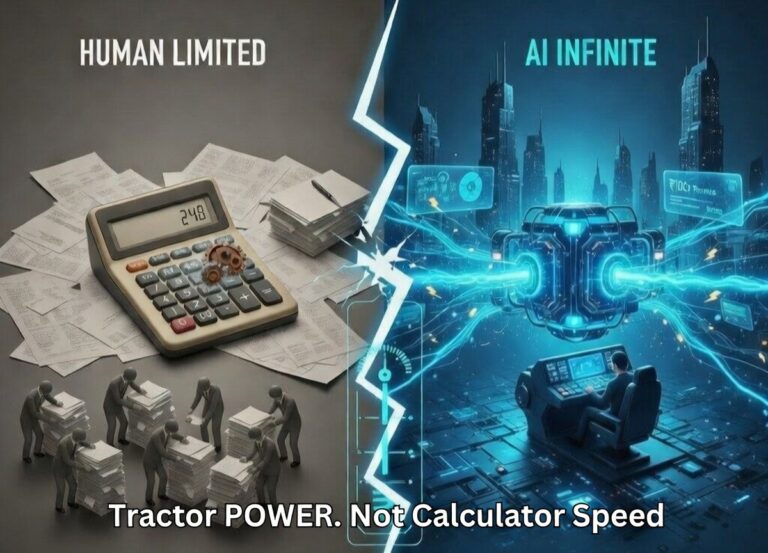
When people first started talking about AI in business, the go-to analogy was the calculator.
The logic seemed sound: just as a calculator helps an accountant crunch numbers faster, AI helps knowledge workers process information faster. Same job, better tool. Nothing to see here.
But that analogy is wrong—and dangerously so.
The more accurate comparison isn’t the calculator. It’s the tractor. And understanding why changes everything about how you should think about AI’s impact on your career, your industry, and your business.
The Calculator Analogy: Comforting, But Incomplete
Let’s be fair to the calculator comparison. It captures something real:
An accountant with a calculator is still an accountant. They still identify entries, categorize transactions, apply judgment to complex situations, and sign off on audits. The calculator just speeds up the arithmetic.
This is augmentation. The tool assists the human. The human remains essential. The job doesn’t fundamentally change.
If AI were just a better calculator, we could all relax. Learn to use the new tool, get more efficient, keep doing what we’ve always done. Simple.
But here’s the problem: AI isn’t sitting on a desk waiting to be told exactly what to do. It’s doing something far more profound.
The Tractor: A Different Kind of Technology
Think about what the tractor actually did to agriculture.
Before mechanization, the size of a farm was limited by how much human and animal power could accomplish in a day. A farmer with horses could plow a certain amount of land, plant a certain number of acres, harvest a certain quantity of crops.
The tractor didn’t just help farmers plow faster. It replaced the entire energy source of agricultural production.
Suddenly, one person could do the work that previously required dozens. Farm sizes could scale beyond anything previously possible. The fundamental economics of agriculture transformed completely.
And the ripple effects went far beyond the farm:
- Urbanization accelerated as fewer workers were needed in agriculture
- Food systems globalized as massive production became possible
- Related industries emerged around mechanized farming equipment, fuel, and large-scale distribution
- The skills required completely changed—from working with animals to operating and maintaining complex machinery
A calculator didn’t reshape cities. The tractor reshaped civilization.
Why AI Fits the Tractor Model ?
Here’s why the comparison matters:
1. AI Replaces "Cognitive Horsepower," Not Just Speed
A calculator speeds up calculations you could theoretically do by hand. It’s faster, not fundamentally different.
AI can do cognitive work that would be literally impossible for humans to do manually—not just slower, but actually impossible.
- Analyzing billions of data points to discover patterns in medical research
- Processing every customer interaction to predict churn before it happens
- Generating thousands of content variations and optimizing in real-time
- Simulating complex scenarios faster than real-time physics
This isn’t making existing work faster. It’s making previously impossible work routine.
2. One Person Can Now Do What Teams Once Did
Before AI, writing a comprehensive market research report required analysts, researchers, editors, and weeks of work.
Now? A skilled AI user can produce comparable output in hours—not because they’re faster at typing, but because the cognitive heavy lifting is handled differently.
This is the tractor effect: not doing the same work faster, but fundamentally changing the ratio of human input to productive output.
3. The Entire Ecosystem Changes
The tractor didn’t just affect farmers. It changed seed companies, equipment manufacturers, rural communities, food distribution, and urban labor markets.
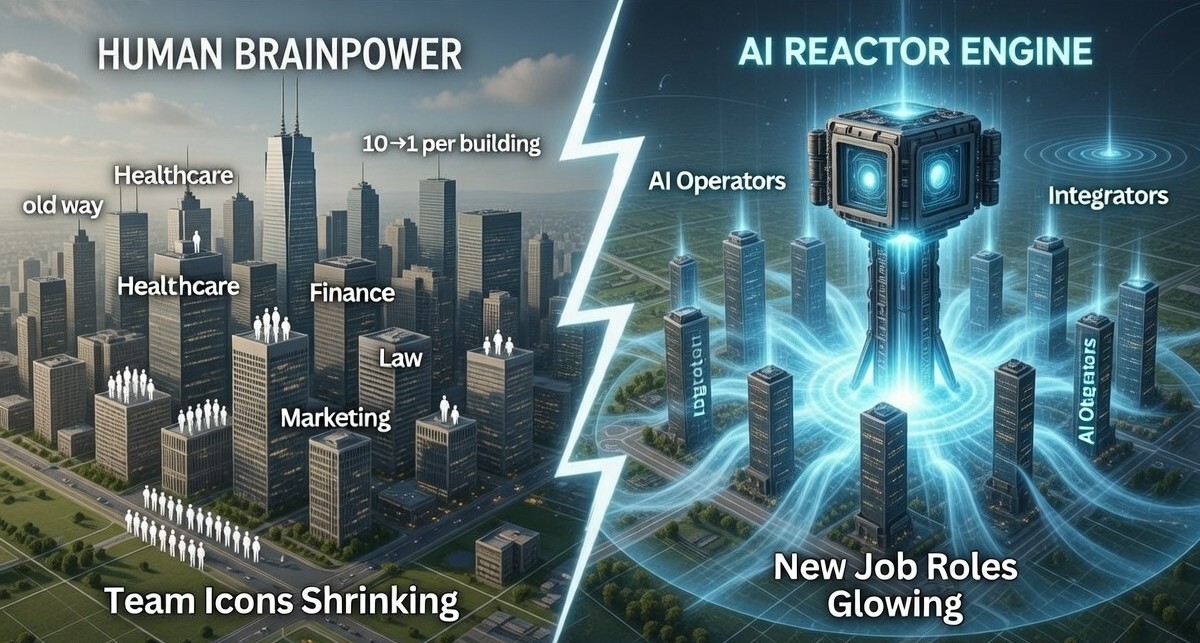
AI is bleeding into healthcare, law, creative industries, customer service, manufacturing, finance—everywhere cognitive work exists. It’s not one industry adopting a new tool. It’s every industry rebuilding around a new capability.
4. The Required Skills Transform Completely
An accountant with a calculator is still doing accounting.
But what happens when AI can:
- Process and categorize transactions automatically
- Flag anomalies that previously required expert review
- Generate reports that once needed manual analysis
- Even provide initial interpretations of complex financial situations?
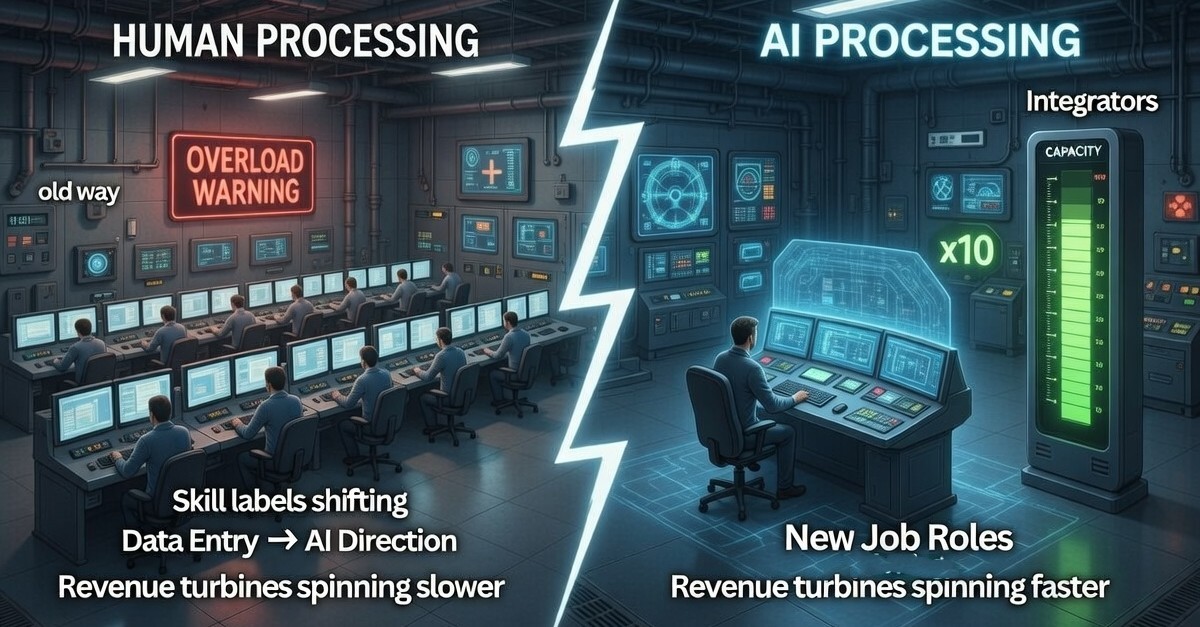
The accountant’s job doesn’t disappear—but it transforms. The value shifts from doing the work to directing AI systems, validating their output, handling exceptions, providing judgment AI can’t replicate, and managing larger-scale operations than one human could previously handle.
You stop being the one pulling the plow. You become the one operating the machinery.
What This Means for You ?
If AI were a calculator, the advice would be simple: learn to use it and continue doing your job slightly faster.
But AI is a tractor, which means:
Your Industry Will Restructure
Every industry where cognitive work matters is going through—or will go through—fundamental restructuring. The question isn’t whether your industry will change, but how fast and in what ways.
"Operator" Skills Become Essential
The new high-value skill isn’t doing the cognitive work yourself. It’s knowing how to:
- Direct AI systems to produce good output
- Evaluate and refine what AI generates
- Handle the edge cases and exceptions AI can’t manage
- Combine AI capabilities in novel ways
- Scale operations that weren’t possible before
Scale Changes Everything
When one person can do what ten could do before, markets respond. Prices may drop. Expectations may rise. What was once a specialized deliverable becomes a commodity.
The opportunity is in doing things that weren’t economically viable before—not just doing old things cheaper.
Adaptation Isn't Optional
Farmers who refused to adopt tractors didn’t preserve traditional farming. They got priced out of the market by those who embraced mechanization.
The same will happen with AI. You can adapt and find new sources of value, or you can watch while others do.
The Heavy Feeling of Progress
There’s a reason this analogy resonates: AI feels heavy.
The calculator felt liberating—less tedious arithmetic! The tractor felt (and was) disruptive—it displaced millions of workers, emptied rural communities, and forced massive social adaptation.
AI carries that same weight of transformation. We’re not just getting better at math. We’re mechanizing cognitive work at a scale that raises real questions:
- What happens to jobs built around cognitive tasks that AI can now handle?
- How do we transition a workforce when the skills required change fundamentally?
- What new opportunities emerge when cognitive tasks become cheap and abundant?
These aren’t hypothetical questions. They’re happening now.
Finding Opportunity in Transformation
The tractor didn’t end human involvement in food production. It changed what that involvement looked like.
Some transitions were painful—the displacement of agricultural workers is a historical fact, not a footnote. But new opportunities emerged: operating advanced equipment, managing large-scale operations, developing agricultural technology, and entirely new industries that made cheap food possible.
AI will follow similar patterns. The question for any individual or business is: where do you position yourself in the new landscape?
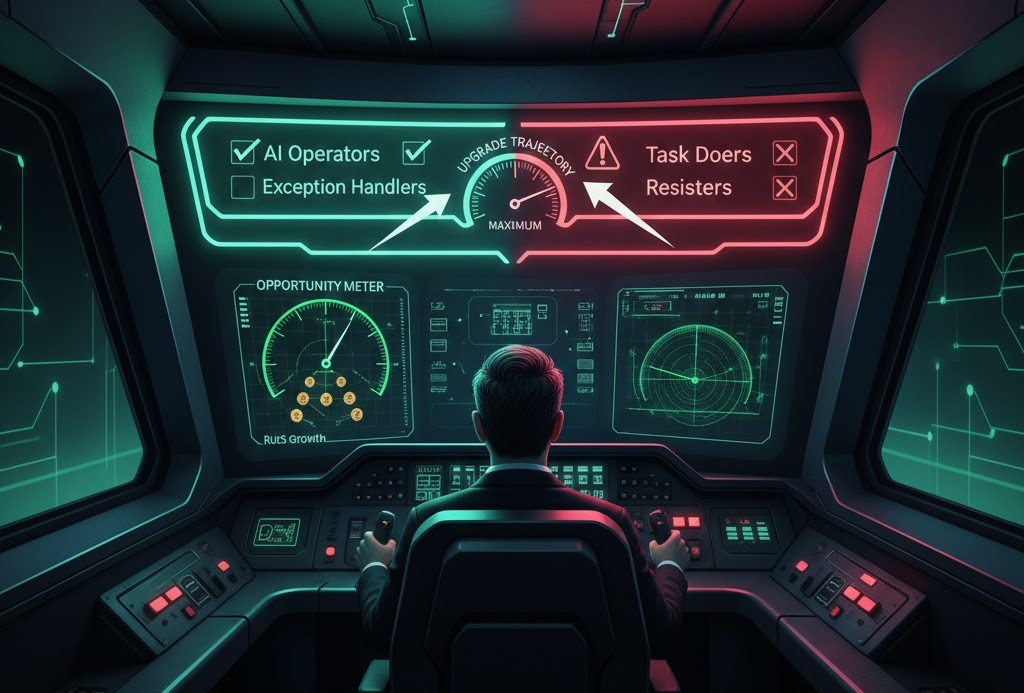
Positions of strength include:
- AI operators: People who can effectively direct and refine AI output
- Exception handlers: Roles focused on the judgment calls AI can’t make
- Integrators: Those who combine AI capabilities across systems
- Relationship roles: Work where human connection is the value, not the task
- Creative directors: Guiding AI generation toward specific visions
- Quality validators: Ensuring AI output meets standards before deployment
The Bottom Line
The calculator analogy let us believe AI would just make us faster at our existing jobs.
The tractor analogy tells a different story: AI is replacing the cognitive “horsepower” of entire industries, enabling one person to do what teams once did, and forcing fundamental restructuring of how work gets done.
This isn’t about learning a new tool. It’s about adapting to a new era of production.
The good news: Understanding this shift early gives you time to adapt—to develop the skills that will matter, position yourself where value will concentrate, and find opportunity in transformation.
The hard truth: The adaptation is real and necessary. The farmers who thrived through mechanization weren’t the ones who resisted change. They were the ones who learned to drive the tractor.
Frequently Asked Questions
Why do people compare AI to a tractor instead of a calculator? The calculator comparison suggests AI just speeds up existing work. The tractor comparison captures something bigger: AI is replacing the cognitive “horsepower” of entire industries, enabling individuals to do what teams once did, and forcing fundamental restructuring of how work happens. It’s not just faster—it’s different.
What does “general purpose technology” mean for AI? A general purpose technology is one that affects multiple industries and triggers widespread changes across the economy. The tractor transformed agriculture; AI is transforming every field where cognitive work matters—healthcare, law, creative industries, customer service, and beyond. These technologies don’t just improve one area; they reshape everything.
Will AI replace my job? Specific tasks will increasingly be handled by AI, but most jobs involve multiple tasks—many of which require judgment, creativity, relationships, or handling exceptions that AI can’t manage. The more likely outcome is job transformation rather than elimination. The key is adapting your skills toward the aspects of work that remain distinctly human.
What skills should I develop for an AI-driven economy? Focus on: directing and refining AI output, evaluating AI-generated work, handling edge cases and exceptions, combining AI capabilities creatively, managing larger-scale operations than previously possible, and any work where human judgment, creativity, or connection is the core value rather than the task execution.
How quickly is this transformation happening? Faster than most people expect. Unlike the tractor’s adoption over decades, AI capabilities are advancing rapidly and adoption is accelerating. Industries are already restructuring around AI capabilities. The time to adapt is now, not when the changes become impossible to ignore.
Is there historical precedent for surviving this kind of change? Yes. Agricultural mechanization, industrial automation, and computerization all transformed work fundamentally while ultimately creating new opportunities. The transitions weren’t painless—real displacement happened—but societies adapted. The key is being proactive rather than reactive about positioning yourself in the new landscape.
Ready to position your business for the AI-driven economy? AI Marketing Technology helps businesses understand and implement AI strategies that create competitive advantage—adapting to the new landscape rather than being disrupted by it.
