
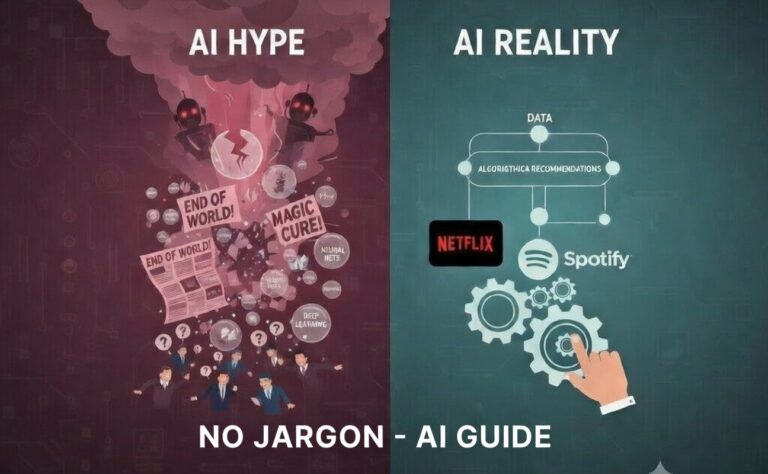
Here’s a confession: “Artificial Intelligence” might be the most overhyped and misunderstood term in technology.
Everyone’s talking about it. Every product claims to have it. Headlines swing between “AI will solve all our problems” and “AI will destroy humanity” with nothing in between.
Meanwhile, most people have no idea what AI actually is.
Is it robot overlords? A magic crystal ball that predicts the future? Some kind of digital brain that thinks like a human? Or just a fancy marketing term that companies slap on everything to sound futuristic?
Let’s cut through the noise and actually understand what we’re dealing with. Because here’s the thing: AI is already woven into your daily life, whether you realize it or not. And understanding it—even at a basic level—matters more than ever.
What AI Actually Is ? (In Plain English)
Strip away all the hype, and here’s the core idea:
Artificial Intelligence is software designed to perform tasks that would normally require human intelligence.
That’s it. That’s the foundation.
Think about things humans do that seem “intelligent”:
- Recognizing faces
- Understanding language
- Making decisions based on complex information
- Learning from experience
- Predicting what might happen next
AI aims to do these things with computers. Not by replicating human consciousness (that’s science fiction, at least for now), but by building sophisticated systems that can process information, identify patterns, and act on them.
The key insight: AI doesn’t “think” the way you do. It doesn’t have experiences, emotions, or awareness. What it does have is the ability to process massive amounts of data and find patterns far faster than any human could.
The Three Flavors of AI You Actually Encounter
When people talk about AI, they’re usually talking about one of these three things:
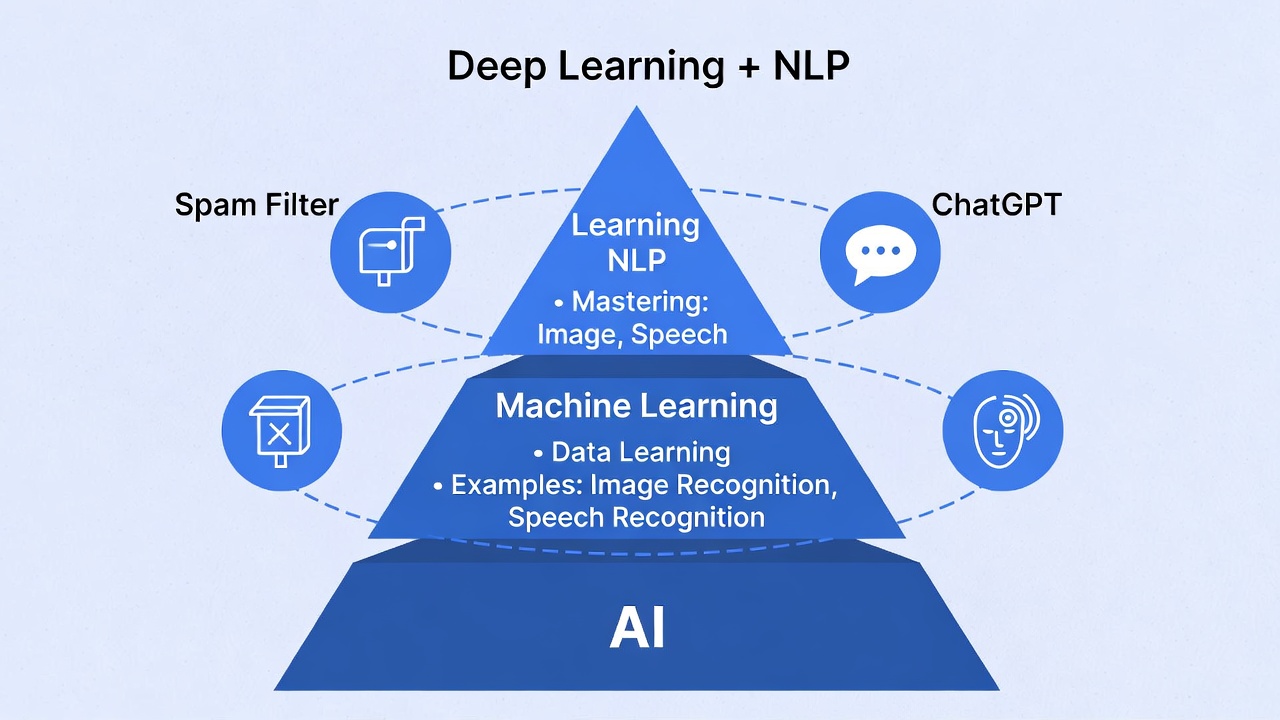
Machine Learning: AI That Learns From Examples
This is the workhorse of modern AI. Instead of being programmed with explicit rules for every situation, machine learning systems learn from data.
Here’s how it works in simple terms:
- You show the system thousands of examples (pictures of cats, customer purchase history, medical scans)
- The system finds patterns in those examples
- It uses those patterns to make predictions about new data it hasn’t seen before
Real-world example: Spam filters. Nobody programs every possible spam pattern. Instead, the system learns from millions of emails that users have marked as spam. It identifies patterns and applies them to new emails.
Deep Learning: Pattern Recognition on Steroids
Deep learning is a specialized type of machine learning that uses structures loosely inspired by the human brain (called neural networks).
These systems excel at complex tasks like:
- Recognizing objects in images
- Understanding spoken language
- Generating human-like text
- Driving autonomous vehicles
Why it matters: Deep learning is behind most of the impressive AI advances you hear about—from ChatGPT to facial recognition to medical diagnosis tools.
Natural Language Processing: AI That Understands Words
NLP is what allows computers to understand, interpret, and generate human language.
This powers:
- Chatbots that answer your questions
- Voice assistants like Siri and Alexa
- Translation software
- The spell-check in your word processor
- AI writing tools
The breakthrough: Modern NLP can understand context and nuance, not just keywords. It knows that “I’m not happy with this bank” probably refers to a financial institution, not a riverbank.
AI You're Already Using (Whether You Know It or Not)
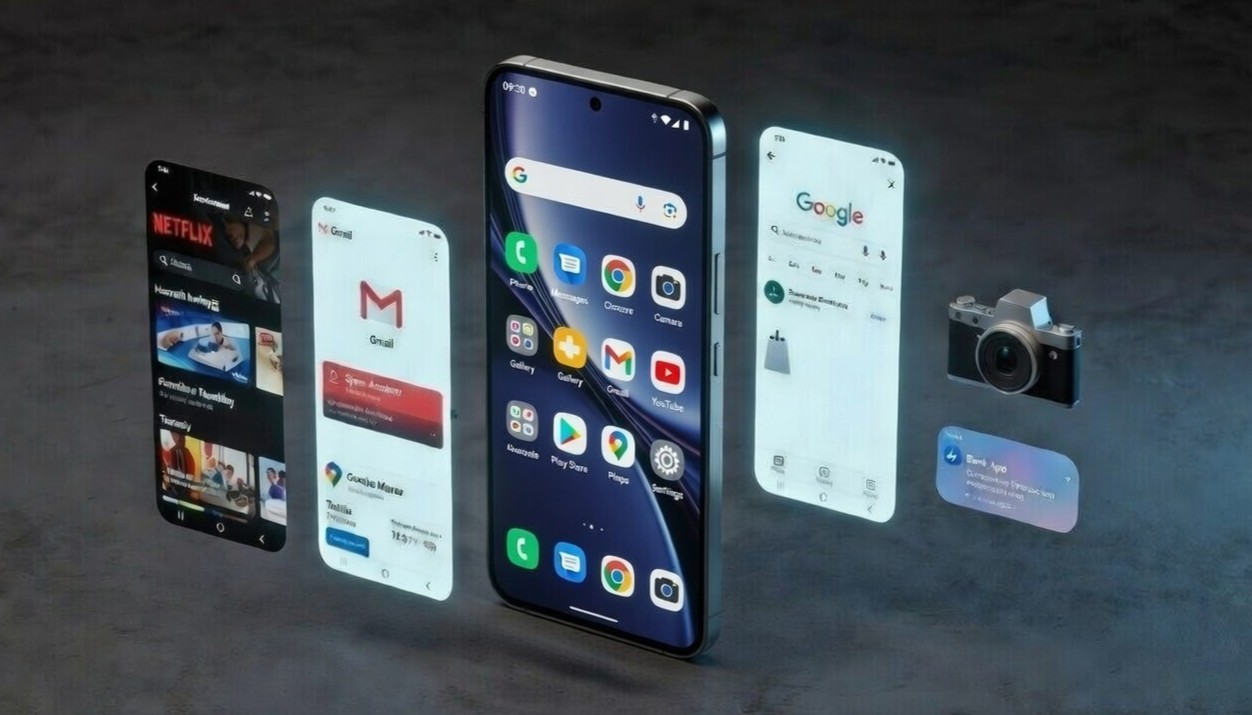
Here’s where it gets interesting. AI isn’t some futuristic thing you might encounter someday. You’re probably interacting with AI dozens of times a day:
Every Recommendation You Get
- Netflix suggesting your next show? AI analyzing your viewing patterns.
- Amazon recommending products? AI predicting what you might buy.
- Spotify’s Discover Weekly playlist? AI learning your music taste.
- YouTube’s homepage? AI deciding what will keep you watching.
Every Time You Search
Google doesn’t just match keywords anymore. AI interprets what you mean and returns results based on context, intent, and patterns from billions of searches.
Your Email Inbox
- Gmail’s spam filter uses AI to keep junk out
- Smart replies suggest responses based on content
- Priority inbox decides what’s important
- Automatic categorization into tabs
Your Phone's Camera
Portrait mode, night mode, automatic scene detection, facial recognition for unlocking—all AI processing images in real-time.
Fraud Protection
Your bank uses AI to spot unusual transactions. That’s why you might get a security alert when you buy something out of pattern.
Navigation
Google Maps and similar apps use AI to predict traffic, suggest routes, and estimate arrival times based on patterns from millions of users.
Why AI Is Suddenly Everywhere ?
AI isn’t new. Researchers have been working on it since the 1950s. So why does it feel like it exploded overnight?
Three things came together:
1. We Created Massive Amounts of Data
AI learns from data. Every search, click, purchase, photo, and message generates data. We now create more data in a single day than humanity created in its entire history before the digital age.
More data = better AI learning = more capable systems.
2. Computers Got Powerful Enough
Training advanced AI requires enormous computing power. The specialized processors (GPUs) that enable modern AI simply didn’t exist or weren’t affordable until recently.
3. The Algorithms Got Better
Researchers made breakthrough discoveries in how to structure AI systems. The “transformer” architecture that powers ChatGPT, for instance, was only published in 2017.
The result: AI went from a specialized research field to a practical tool that can run on your phone.
What AI Can't Do ? (At Least Not Yet)
Understanding limitations is just as important as understanding capabilities:
AI Doesn't Actually "Understand"
When ChatGPT writes a coherent essay, it’s not understanding the topic the way you would. It’s predicting what words should come next based on patterns in its training data. The results can look like understanding, but the mechanism is fundamentally different.
AI Can't Explain Its Reasoning (Usually)
Most AI systems are “black boxes.” They produce outputs, but can’t explain why they reached those conclusions in terms humans can follow. This is a real problem in high-stakes applications like medical diagnosis or legal decisions.
AI Reflects Its Training Data
If the data used to train an AI system contains biases, the AI will reproduce those biases. This has caused real problems: facial recognition systems that work poorly on darker skin tones, hiring algorithms that discriminate against women, loan systems that reinforce historical inequities.
AI Doesn't Have Common Sense
AI can be brilliant at narrow tasks and completely helpless at things a child could do. An AI that beats world champions at chess might not understand that a bishop can’t jump over other pieces if asked in natural language.
The Hype vs. Reality Gap
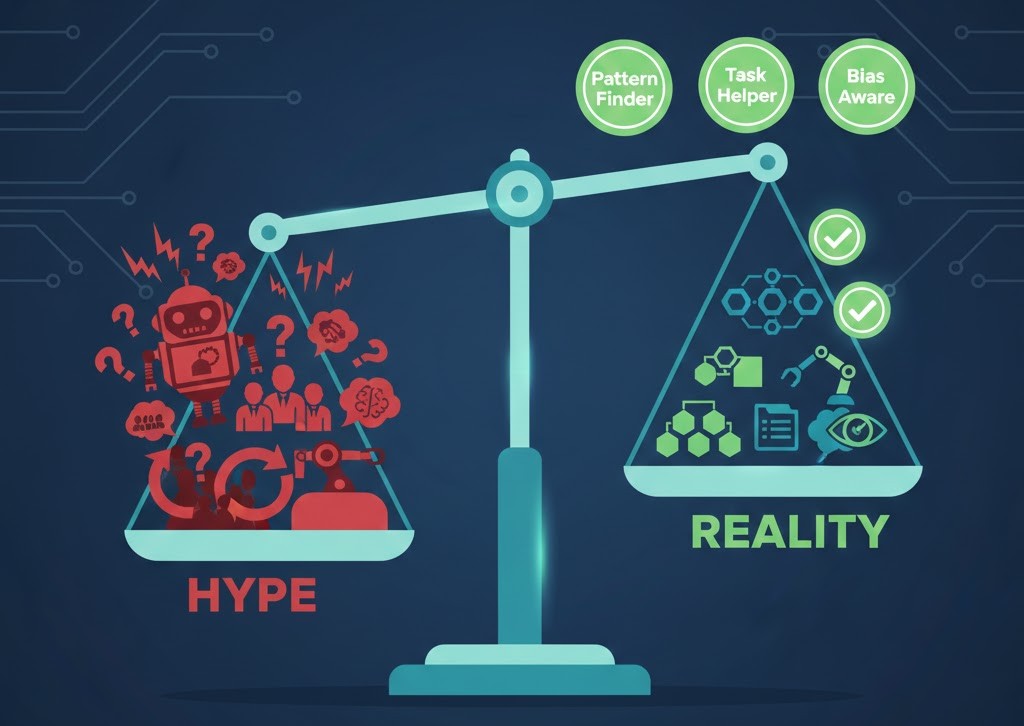
Let’s be honest about what AI marketing claims versus what AI actually delivers:
The Hype | The Reality |
AI will replace all human workers | AI automates specific tasks, not entire jobs (mostly) |
AI can do anything | AI is very good at narrow, well-defined tasks |
AI is unbiased and objective | AI inherits biases from its training data |
AI understands like humans | AI predicts patterns; it doesn’t comprehend |
AI is a magical black box | AI is math and statistics at scale |
The truth is somewhere in between: AI is genuinely transformative for many applications, but it’s a tool with real limitations—not magic, and not the robot apocalypse.
Why This Matters for You ?
Understanding AI—even at a conceptual level—is increasingly essential because:
AI shapes what you see. The content in your feeds, search results, and recommendations is curated by AI systems you don’t control.
AI is making decisions about you. Whether you get approved for a loan, what price you see for a flight, whether your resume gets past the first screen—AI is often involved.
AI is changing how work gets done. The jobs that exist, the skills that matter, and how businesses operate are all being reshaped by AI capabilities.
AI literacy is becoming basic literacy. Just like you don’t need to be a programmer to use a computer, you don’t need to build AI systems to understand what they can and can’t do.
The Bottom Line
AI isn’t a single thing. It’s a broad field of techniques that enable computers to perform tasks that seem intelligent.
It’s already embedded in services you use every day. It’s genuinely powerful for specific applications. And it’s neither the salvation nor the destruction of humanity—it’s a tool, with all the benefits and risks tools have always carried.
The best stance isn’t fear or hype. It’s an informed engagement. Understand what AI is, what it isn’t, and how it affects your life. That understanding gives you power in a world increasingly shaped by these systems.
Frequently Asked Questions
What is artificial intelligence in simple terms? Artificial intelligence (AI) is software designed to perform tasks that typically require human intelligence—like recognizing images, understanding language, making decisions, and learning from experience. It works by processing large amounts of data and finding patterns, not by thinking the way humans do.
What’s the difference between AI, machine learning, and deep learning? AI is the broad field of creating intelligent systems. Machine learning is a subset of AI where systems learn from data rather than explicit programming. Deep learning is a specialized type of machine learning using neural networks that excel at complex tasks like image recognition and language processing.
Is AI actually intelligent? Not in the human sense. AI doesn’t have consciousness, understanding, or awareness. It’s very good at finding patterns and making predictions based on data, which can produce results that appear intelligent. But the mechanism is fundamentally different from human thinking.
What AI do I use in daily life? You likely interact with AI dozens of times daily: email spam filters, social media feeds, search results, streaming recommendations, voice assistants, photo apps, navigation, fraud protection, autocorrect, and many more. Most digital services now incorporate AI in some form.
Will AI take my job? AI automates specific tasks rather than entire jobs. Most likely, AI will change what your job involves rather than eliminate it entirely. Jobs with highly repetitive, predictable tasks are most affected. Jobs requiring creativity, complex judgment, and human connection are more resilient—though they’ll still change.
Should I be worried about AI? Informed concern is reasonable; panic isn’t necessary. AI raises real questions about bias, privacy, job displacement, and decision-making accountability. But understanding AI helps you navigate these issues. The goal is engagement and understanding, not fear.
Want to understand how AI can work for your business specifically? AI Marketing Technology helps businesses cut through the hype and implement AI solutions that actually deliver results—no robot overlords required.
