
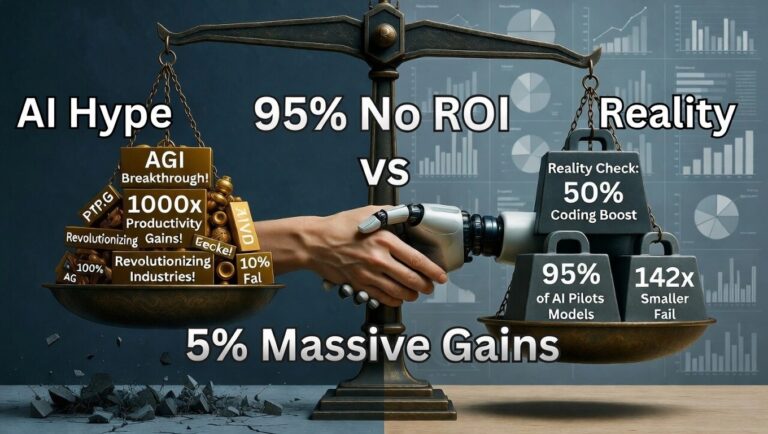
We’ve officially entered the era of AI evaluation.
The breathless headlines and evangelism of the early 2020s have given way to something more useful: actual evidence of what AI can do, what it can’t, and where the gap between promise and reality lies.
So let’s have an honest conversation. Is AI really as powerful as the predictions suggested? The answer is nuanced—and probably not what you expect from either the hype or the skepticism.
The 2026 Reality Check: What the Data Actually Shows
The ROI Gap
Here’s a number that might surprise you: 95% of organizations are currently seeing zero or negligible return on their generative AI investments.
Wait—doesn’t that mean AI is a bust?
Not quite. Here’s the full picture:
- 88% of businesses are using AI in at least one function
- Most are stuck in “pilot purgatory”—experimenting but not deploying at scale
- The 5% who have integrated AI successfully are seeing massive gains
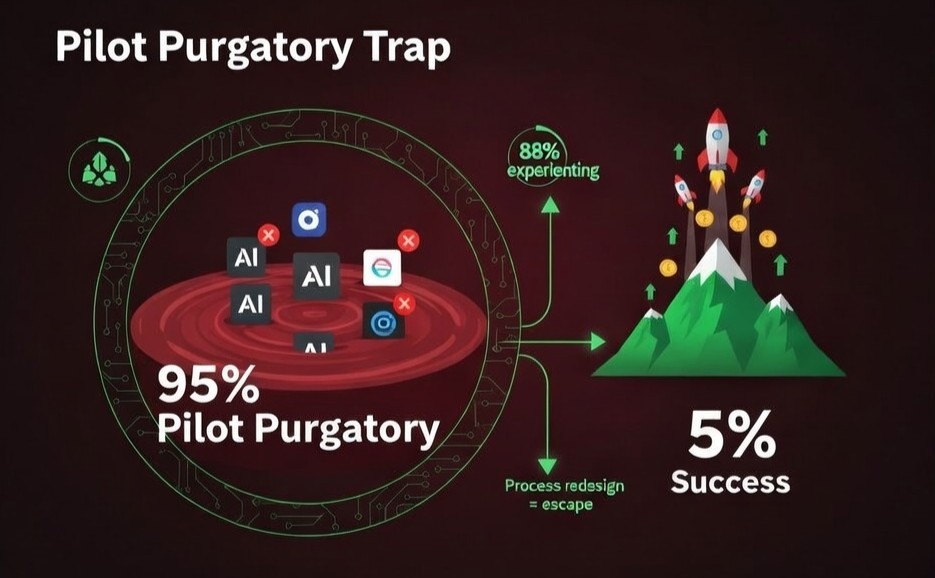
The insight: AI is powerful, but realizing that power requires more than just adopting the technology. It requires integrating it into actual business processes.
The Efficiency Gains Are Real
For businesses that have figured out how to use AI effectively, the results are genuinely transformational:
Application | Efficiency Gain |
AI-assisted coding | 50%+ time reduction |
Research and analysis | 40-60% faster |
Customer service automation | 30-50% cost reduction |
Content creation workflows | 3-5x faster production |
Data processing and reporting | 70%+ time savings |
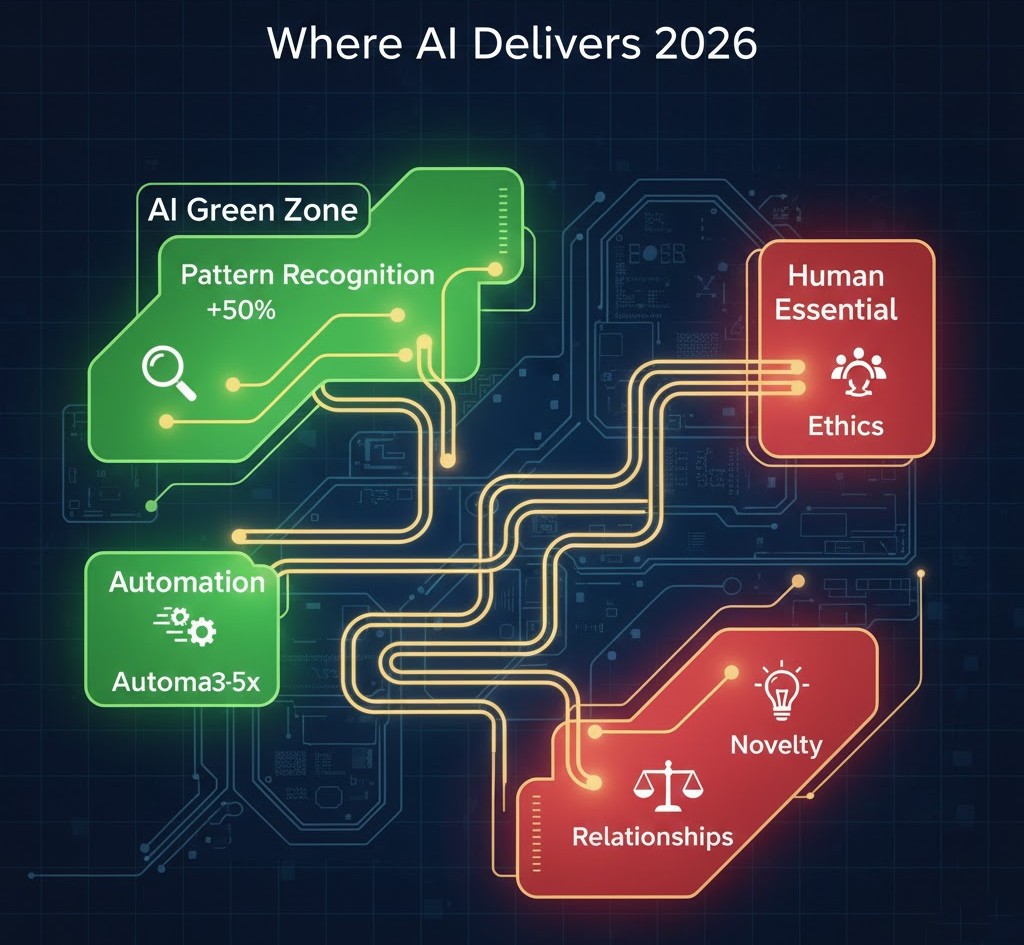
The pattern: AI excels at tasks that involve processing information, recognizing patterns, and generating structured outputs. The gains are concentrated—but they’re substantial.
The Cost Revolution
Here’s something that often gets lost in the conversation: AI has become dramatically more accessible.
- Modern AI models are 142x smaller than 2022’s behemoths while delivering similar performance
- Training costs have plummeted
- Quality open-source models now compete with proprietary ones
- Running AI locally is increasingly viable
What this means: “Powerful AI” is no longer the exclusive domain of tech giants. Small businesses can access capabilities that were science fiction five years ago.
Where AI Power Is Real ?
Agentic AI: From Chatbot to Chief of Staff
The most significant shift in 2026 isn’t just talking to AI—it’s AI that takes action.
Agentic AI refers to systems that don’t just generate plans or suggestions. They execute tasks, interact with other systems, and accomplish goals with minimal human intervention.
What agentic AI handles well:
Task Type | Example | Why It Works |
Deterministic workflows | IT ticket routing | Clear rules, predictable patterns |
Data processing | Bookkeeping automation | High volume, structured data |
Research synthesis | Market analysis | Information gathering and summarizing |
Scheduling and coordination | Meeting management | Rule-based decision making |
Basic customer service | FAQ responses | Pattern matching to known solutions |
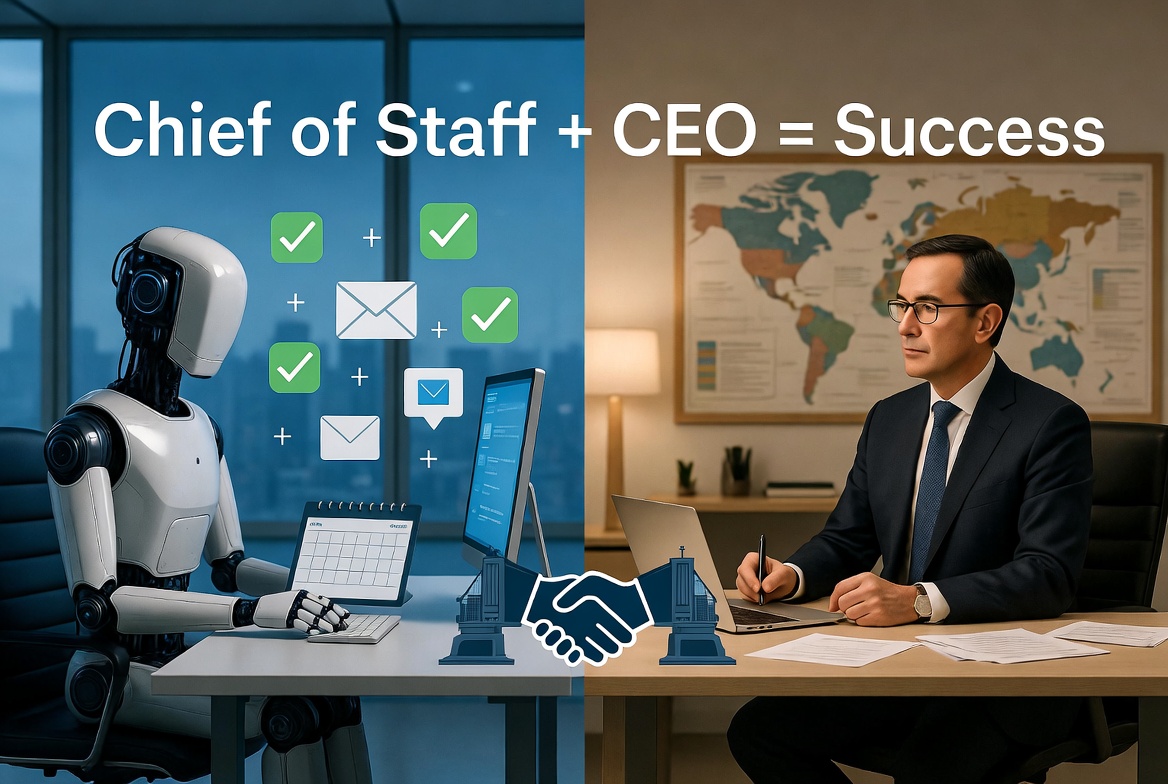
The honest limitation: Agentic AI excels as a “Chief of Staff”—handling execution and coordination—but still requires a human “CEO” for judgment calls, strategy, and novel situations.
Pattern Recognition at Scale
AI’s core strength is finding patterns in data that humans would miss or take forever to identify.
Business applications:
- Predicting customer churn before it happens
- Identifying fraud patterns in financial transactions
- Personalizing recommendations from behavior data
- Optimizing pricing based on demand patterns
- Detecting equipment failures before they occur
In these domains, AI doesn’t just match human capability—it exceeds it by orders of magnitude.
Content Generation and Transformation
AI can create and transform content faster than humans, with quality that ranges from “good enough” to “genuinely impressive”:
- Drafting marketing copy and email sequences
- Generating variations for A/B testing
- Translating content across languages
- Summarizing lengthy documents
- Creating code and technical documentation
The caveat: AI-generated content still benefits significantly from human review, especially for anything requiring nuance, brand voice, or factual accuracy.
Where AI Falls Short ? (Honestly)
The Reasoning Wall
One of the most important findings from 2026 AI research: Large Language Models suffer from accuracy collapse when faced with logic problems that deviate slightly from their training data.
In plain English: AI can look like it’s reasoning, but it’s actually sophisticated pattern matching. When it encounters something truly novel—even if it’s logically simple—performance drops dramatically.
What this means practically:
- AI excels at problems similar to what it’s seen before
- AI struggles with genuinely novel situations
- “Common sense” reasoning remains a weakness
- Verification of AI outputs remains essential
Human Connection and Care
Nowhere are AI’s limitations more obvious than in contexts requiring genuine human connection.
Research has found that AI therapy chatbots, for example, can actually harm certain vulnerable populations. For the relational work of healing, support, and care, AI remains a poor substitute for human presence.
Domains where humans remain essential:
- Mental health and emotional support
- High-stakes healthcare decisions
- Complex negotiations and conflict resolution
- Creative direction and artistic vision
- Ethical judgment in ambiguous situations
Context and Nuance
AI systems operate on explicit information. They miss:
- Organizational politics and history
- Cultural nuance and unspoken norms
- The “why” behind decisions
- Implicit knowledge that experts take for granted
- Changing contexts that aren’t reflected in data
This is why AI augments human expertise rather than replacing it—the human provides context that AI cannot acquire on its own.
The 2030 Outlook: Where This Is Heading
From Apps to Interfaces
The current model—open ten different apps to accomplish a task—is temporary. By 2030, you’ll more likely tell your AI assistant what you want to accomplish, and it will orchestrate the services in the background.
Implications for businesses:
- Customer interactions will increasingly be AI-mediated
- “Discoverability” will matter more than direct traffic
- The businesses AI recommends will win
Physical Integration
AI is moving from screens into the physical world:
- Self-routing logistics and supply chains
- Predictive maintenance across industries
- Healthcare monitoring and early intervention
- Automated quality control in manufacturing
- Smart infrastructure management
The Energy Bottleneck
Here’s a constraint that gets less attention than it deserves: AI requires enormous amounts of energy.
By 2030, training frontier models will require gigawatts of power. The “power” of AI may literally be limited by the electrical grid. Energy efficiency and access will become competitive advantages.
What This Means for Your Business
The Realistic Opportunity
AI isn’t going to run your business while you sleep. But it can:
- Dramatically increase productivity on specific tasks
- Enable capabilities you couldn’t afford before
- Provide insights from data you weren’t using
- Free human time for high-value work
- Create competitive advantages if adopted thoughtfully
The Adoption Principle
The 95% of companies seeing no ROI from AI share common patterns:
- Treating AI as a technology project rather than a business change
- Not investing in process redesign
- Expecting AI to work without integration
- Chasing hype rather than solving real problems
The 5% getting results:
- Starting with specific, measurable problems
- Redesigning workflows to incorporate AI
- Investing in training and change management
- Iterating based on actual outcomes
- Maintaining realistic expectations
Questions to Ask Before Investing
Before adopting any AI solution, honestly assess:
- What specific problem does this solve for our business?
- How will we measure success?
- What process changes are required for this to work?
- Do we have the data and infrastructure needed?
- Who will own implementation and optimization?
- What’s the realistic timeline to value?
The Bottom Line
Is AI as powerful as the predictions suggested? Yes and no.
AI’s capabilities are genuinely impressive in specific domains—pattern recognition, information processing, content generation, and automation of structured tasks. The businesses that have integrated AI thoughtfully are seeing substantial returns.
But AI is not the general-purpose intelligence that some predicted. It doesn’t “think” in any meaningful sense. It excels at what it was trained to do and struggles with novelty, nuance, and genuine reasoning.
The practical takeaway: AI is a powerful tool. Like any tool, its value depends entirely on how it’s applied. The hype and the skepticism are both wrong—reality is more interesting than either.
The businesses that win in the AI era won’t be the ones who adopt every new capability. They’ll be the ones who understand what AI actually does well, apply it to real problems, and maintain the human judgment that AI cannot replace.
Frequently Asked Questions
Is AI really as powerful as the headlines suggest? Yes and no. AI excels at specific tasks—pattern recognition, data processing, content generation—where it often outperforms humans. But it’s not general intelligence. It struggles with novel situations, genuine reasoning, and anything requiring human judgment or connection.
Why are most companies not seeing ROI from AI? Most companies are stuck in experimentation rather than deployment. Successful AI implementation requires process redesign, integration work, and organizational change—not just technology adoption. The companies getting results invested in transformation, not just tools.
Can AI replace human workers? AI replaces specific tasks, not entire jobs. The pattern is augmentation: AI handles repetitive, data-heavy work while humans focus on strategy, creativity, judgment, and relationship-building. The jobs most at risk are those consisting primarily of automatable tasks.
What can AI not do well? AI struggles with genuine reasoning (as opposed to pattern matching), understanding context and nuance, building human relationships, making ethical judgments, and handling situations significantly different from its training data.
Should small businesses invest in AI? Yes, selectively. The cost of powerful AI has dropped dramatically. Small businesses can access capabilities that were previously exclusive to large enterprises. The key is starting with specific problems rather than general “AI adoption.”
What will AI look like in five years? Expect AI to become more integrated into everyday tools and workflows, more capable of taking actions (not just generating content), and more energy-intensive. The interface will shift from chatbots to ambient assistance. But fundamental limitations around reasoning and context will likely persist.
Want to understand how AI can practically help your business? AI Marketing Technology helps businesses navigate the AI landscape with solutions that deliver measurable results, not just impressive demos.
